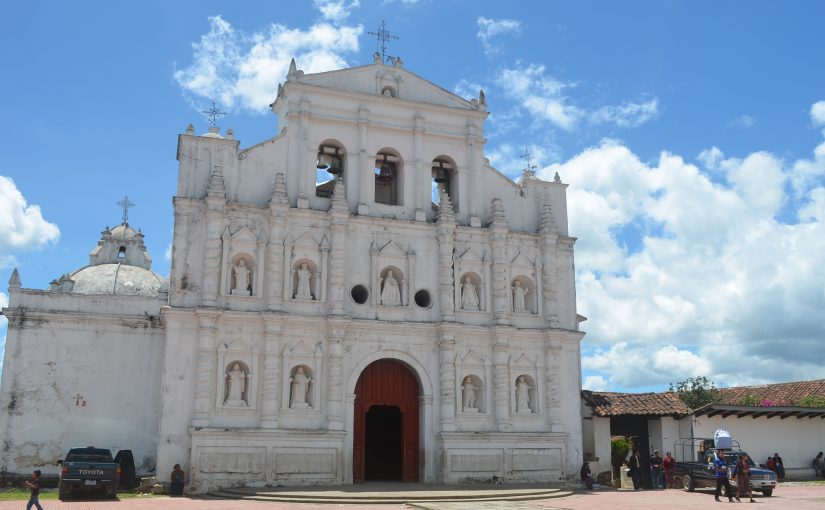
In this unit we will study negation in K’iche’. We will use the particles na and ta(j) to create negative sencences.
Verb negation
Negative clauses in K’iche’ require two negation particles: na preceding the predicate head–which can be a verb, adjective, noun or pronoun–and ta(j) following it. Na is often deleted in colloquial speech. There are two variants of the second particle: taj in phrase-final position and ta elsewhere.
To answer “no” in K’iche’, the whole verb phrase is repeated and negated.
La kixwarik? La k-ix-warik? INT INC-2pl-sleep-pfm Are you all sleeping? Na kujwar taj. Na k-uj-war taj Neg1 INC-1pl-sleep Neg2 We aren’t sleeping. Na kujwar ta waral. Na k-uj-war ta waral Neg1 INC-1pl-sleep Neg2 here We don’t sleep here. Na kawar ta la. Na ka-ø-war ta la Neg1 INC-ø-sleep Neg2 2singF You aren’t sleeping. (Second person singular, formal)Here are a couple more examples:
La katb’in pa le uxlanb’al? La k-at-b’in pa le uxlanb’al? INT INC-2sing-walk loc. art. park Are you walking to the park? Na kimb’in taj. Na k-im-b’in taj Neg1 INC-1sing-walk Neg2 I am not walking. La kixpe pa tijob’al? La k-ix-pe pa tijob’al? INT INC-2pl-come loc. school Are y’all coming to school? Na kojpe taj. Na k-oj-pe taj Neg1 INC-1pl-come Neg2 We are not coming.
These are some more common intransitive verb roots:
| b’in(ik) | to walk, to travel |
| b’e(k) | to go |
| pe(tik) | to come |
| kape le jab’ | “it starts to rain” |
| kos(ik) | to be/become tired |
| qaj(ik) | to descend, to go down |
| kinqaj chuwach le juyub’. | “I descend the mountain” |
| wa'(ik) | to eat |
| ch’aw(ik) | to talk |
| ka’y(ik) | to see, to look |
| chakun(ik) | to work |
| kam(ik) | to die |
| war(ik) | to sleep |
| b’ixan(ik) | to sing |
| ki’kot(ik) | to be happy |
| b’ison(ik) | to be unhappy, sad |
| t’uyi'(k) | to sit |
| tak’i'(k) | to stand |
You will hear a series of questions. Listen carefully and answer them both in the positive and the negative:
Answers
- Je’ kinchakunik; Na kinchakun taj.
- Je’ kaki’kot le achi; Na kaki’kot ta le achi.
- Je’ kakos le b’anal si’; Na kakos ta le b’anal si’.
- Je’ kape jab’; Na kape ta le jab’.
- Je’ kimb’isonik; Na kimb’ison taj.
- Je’ kojb’e awuk’ pa le nimatijob’al; Na kojb’e ta awuk’ pa le nimatijob’al.
- Je’ kojwa’ik; Na kojwa’ taj.