Category: English

  • Tïjonik 16 (Unit 16) Tajin Kinweta’maj (I am learning): Auxiliary Verbs

    Tïjonik 16 (Unit 16) Tajin Kinweta’maj (I am learning): Auxiliary Verbs

    In this lesson, we will learn about several helping (i.e. auxiliary) verbs.

    The following shows the common use of some auxiliary verb-construction (in English auxiliary verbs are usually followed by the infinitive, like in I want to cry). In K’iche’ a second full verb is often used after the auxiliary.

    Kowinik “to be able to”: The main verb follows a form of “kowinik,” with which it agrees in person and aspect.

    Kinkowinik kimb’ek. K-in-kowin-ik k-im-b’e-k INC-1sing-be able to-pfm  INC-1sing-go-pfm. I can go.

    Xatkowinik xab’ano. x-at-kowin-ik x-a-b’an-o COMP-2sing-be able to-pfm COMP-2sing-do-pfm. You were able to do it. / You could do it.

    Kinkowinik kink’am b’i le pwaq we karaj le nutat. k-in-kowinik  k-in-k’am  b’i  le  pwaq we ka-r-aj le nu-tat INC-1sing-be able to   INC-1sing-take  directional art. money if INC-3sing-want art. my-dad I can take away the money if my dad wants.

    La kakowin alaq kinto’ alaq? La ka-Ø-kowin alaq k-in-Ø-to’ alaq? INT INC-Ø-be able to 2pl INC-1sing-Ø-help? Can you all (formal) help me?

    Aj “want” (vtr): In a construction with the verb aj “want” the following main verb does not have to agree in person with –aj-.
    Kawaj ka-w-aj I want (it)
    Kaqaj Ka-q-aj We want (it)
    Kawaj k-aw-aj You want (it)
    Kiwaj k-iw-aj You (pl) want (it)
    Kaj la K-Ø-aj la You (formal) want (it)
    Kaj alaq k-Ø-aj alaq You (formal, pl) want (it)
    Karaj ka-r-aj He/she wants (it)
    Kakaj ka-k-aj They want (it)
    [sc_embed_player fileurl=”https://tzij.coerll.utexas.edu/wp-content/uploads/auxiliar_15_ex-kawaj-kimbe-pa-tinamit.mp3″]Kawaj kimb’e pa tinamit. Ka-w-aj k-im-b’e pa tinamit. INC-1sin-want INC-1sing-go loc. town I want to go to town

    Xawaj xab’ano. x-aw-aj x-a-b’an-o COMP-2sing-aj COMP-2sing-do-pfm You wanted to do it.

    La kaj la kujtzalij la aninaq? La k-Ø-aj la k-uj-tzalij la aninaq? INT INC-Ø-want 2sing,formal INC-1pl-return dir. fast Do you (formal) want us to return here quickly?

    La kaj la koje’xojowa chwe’q? La k-Ø-aj la k-oj-e’-xojow-a chwe’q? INT INC-Ø-want 2sing,form. INC-1pl-incorporated movement-dance-PFM tomorrow Do you (formal) want us to go dance tomorrow?

    Rajawaxik “it is necessary”, “to need”: The irregular passive stem (ajawaxik) of the verb aj “want” becomes the base for the phrase rajawaxik “it is necessary.” The subject and nature of the need is expressed in a following verb. “Rajawaxik” may also be used as a noun: a necessary thing.

    Rajawaxik katzijon le nan ruk’ le tat. It is necessary that the mom talk to the dad.

    Rajawaxik kaya’ kan le pwaq wuk’ in. It is necessary to leave the money with me.

    Rajawaxik kaya’ kan le qawa rumal le aj ik’. It is necessary that our maid give us food.

    Jas rajawaxik kab’anik? What must be done?/ What’s necessary to be done?

    Chab’ij chwe we k’o jun rajawaxik. Tell me if you have a need/if you need something.

    Tajin : describes an ongoing action or an event happening at the same time as another (“progressive” English: I am/was talking). In K’iche this idea is expressed by the word katajin(ik), which is the followed by a transitive or intransitive verb in the incompletive aspect (with proper person). In colloquial speech katajin is shortened to tajin.

    Progressive action in incompletive: katajin + verb in incompletive:
    Katajin ku’l le winaq chanim. The people are arriving now. Progressive action in completive : katajin + verb in incompletive; context makes it clear that event is in the past time:
    Katajin kajosq’ix le ulew aretaq xinopan chi la’. The land was being cleaned when I arrived there. Progressive in future time: katajin + verb; context makes it clear that event takes place in the future:
    Katajin kewa’ le winaq aretaq xujok pa ja. The people will be eating when we enter the house.

    Here are a few more examples:

    Katajin kujwa’ik. We are eating.

    Katajin kixukunaj le itat. Your father is healing you (all).

    Katajin kinkunax waral. I am being healed here.

    Katajin kekunataj le e yawab’ib’. The sick people are being healed.

    La katajin kakunan le ajkun che la? Is the doctor healing you (formal)?

    Lal katajin kakunan la le ne’. You (formal) are healing the baby.


    k’ulanem wedding
    ab’ix cornfield, milpa
    eleb’al bathroom
    uwach ulew the (face of the) Earth
    sutz’ cloud
    b’inel ja’ river
    k’is(o) (vtr) to finish, to run out
    tzaj(ik) (vit) to dry up
    b’in(ik) (vit) to walk, (to go, to move)
    k’iy(ik) (vit) to grow (plants)

    Translate the following phrases into English:

    1. La kakowin alaq kab’e alaq pa le nuk’ulanem?
    2. We kawaj kab’ano, katkowinik kab’ano.
    3. Sib’alaj kakowin le ali kaxojowik.
    4. Rajawaxik le jab’ arech kak’iy le ab’ix.
    5. Rajawaxik kinb’e pa le eleb’al.
    6. Rajawaxik kinb’e pa ro’ch le a Wel.
    7. Rajawaxik kaqachajij le uwach ulew.
    8. Katajin kab’in le sutz’ chwach le kaj.
    9. Katajin katzaj taq le b’inel taq ja’ pa iximulew.
    10. Katajin kak’is le che’ pa we qatinamit.
    Answers
    1. Can you all (formal) come to my wedding?
    2. If you want to do it, you can do it.
    3. The young woman can really dance.
    4. Rain is needed so that the cornfield can grow.
    5. I need to go to the bathroom
    6. I need to go to Manuel’s house.
    7. We need to protect the world.
    8. The cloud is walking across the sky.
    9. The rivers are drying up in Guatemala.
    10. The jail is being finished in our town.
  • Tïjonïk 15 (Unit 15) Kinusik’ij le nunan (My mother calls me): Transitive Verbs

    Tïjonïk 15 (Unit 15) Kinusik’ij le nunan (My mother calls me): Transitive Verbs

    In Lesson 10 we discussed intransitive verbs. In this lesson we will study transitive verbs, which are different in that they have not only a subject but also an object marker.

    The morphology of K’iche’ transitive verbs is different than that of transitive verbs in both English and Spanish. As in Spanish and English, transitive verbs in K’iche’ are marked for the subject or agent. But unlike Spanish and English, in K’iche’ they are also marked for the object. This means that verbs carry morphemes referring to both subject and object. Linguists call the former ergative markers (set A) and the latter absolutive markers (set B). The following examples are consonant initial verbs. We will study vowel-initial verbs later.

    Ex. 1 Kinusik’ij le nunan. K-in-u-sik’ij le nu-nan K     –  in     –   u  –   sik’ij         le            nu  –  nan Inc  –  1sB  – 3sA-   call         art.     1sPos  –  mamá My mother calls me

    Abbreviations: Inc = Incompletive Aspect; 1sB First Person Singular, Set B; 3sA = Third person singular, set A; 1sPoss = First person singular, possessive

    In example 1, the absolutive marker (Set B) /-in-/ denotes the object “me” and the ergative marker (Set A) /-u-/ the subject “she.” Note that both subject and object are marked in the verb itself. Ergative markers are known as “set A” and absolutive markers as “set B.” The prefix /k-/ is the incompletive marker, as you know, and the verbal root is /sik’ij/.

    Ex. 2 Xixqach’ab’ej iwir. X-ix-qa-ch’ab’ej iwir. X         –    ix      –  qa   –   ch’ab’ej    iwir Comp. –  2pB  –  1pA  –   speak     yesterday We spoke to you all yesterday.

    Abbreviations: Comp. = Completive Aspect; 2pB = Second person plural, Set B; 1pA = First person plural, Set A.

    In Ex. 2 the prefix /x-/ is the completive marker; /-ix-/  marks the second person plural object “you all”; /-qa-/ marks the subject, first person plural “we” and /-ch’ab’ej/ is the verbal root.

    The following table is a preliminary summary of the morphology of K’iche’ transitive verbs:
    Tense/Aspect Object (Set B) Subject (Set A) Root
    k(a) – (incompletive) -in- (1st person sing.) -in- (1st person sing.) -sik’ij (to call) Ex. 1
    -at- (2nd person sing.) -a- (2nd person sing.)
    x- (completive) -Ø- (3rd person sing.) -u- (3rd person sing.)
    -oj- (1st person pl.) -qa- (1st person pl.)  -ch’ab’ej(to speak to) Ex. 2
    Note: The weak /a/ in ka- disappears when the object pronoun starts with a vowel -ix- (2nd person plural) -i- (2nd person plural)
    -e- (3rd person plural) -ki- (3rd person plural)
     

    Kinds of transitive verbs

    According to their morphology, K’iche’ has two kinds of transitive verbs:

    1) Root Transitives: The root has the form CVC (C = consonant; V = vowel). In phrase-final position they take a phrase-final marker: /-u/ if the verbal root’s vowel is /u/ and /-o/ in all other cases.

    Ex. 3 La xaloq’ jun alej? la x-Ø-a-loq’ jun a-lej la       x     –   Ø   –   a   –   loq’         jun       a  –   lej Int. Comp.-3sB-2sA  –  to buy      a         2sPos-tortilla Did you buy (yourself) a tortilla?

    Abbreviations: Int = Interrogative particle; Comp. = Completive aspect; 3sB = Third person singular, Set B; 2sA =Second person singular, Set A; 2sPoss = Second person singular, Possessive.

    Je’, xinloq’o. je’ x-Ø-in-loq’-o je’    x  –     Ø   –     in    – loq’    -o yes Comp-  3sB- 1sA  –  buy-  PFM Yes, I bought it.

    Abbreviations: Comp. = Completive aspect; 3sB = Third person singular, Set B; 1sA = First person singular, Set A;  PFM = Phrase final marker.

    In Ex. 3, when the verb appears in phrase final position, it takes the phrase final marker /-o/, which echoes the root vowel in /loq’/ “buy.”

    Ej. 4 La xib’an le ichak? La x-Ø-i-b’an le i-chak? La  –      x     –     Ø   –    i    –  b’an    le          i      –   chak. Int. – Comp.  – 3sB – 2pA – to do  art.  2pPoss  –  work. Did you all do your work?

    Je’ xqab’ano. Je’ x-qa-b’an-o. Yes     x    –   Ø  – qa – b’an   –  o. Yes Comp-3sB-1sA- to do  –  PF. Yes, we did it. 

    Na xqab’an taj. Na x-Ø-qa-b’an taj. Na      x –   Ø   –  qa   – b’an    taj. Neg1  x – 3sB – 1pA – to do Neg2. No, we didn’t do it. 

    Notice, in example 4, that when the verb is in phrase final position, it takes on a phrase final marker, /-o/ in this case. Also, Notice that because “chak” “work” is third person singular, the marker Ø (zero) occupies the place of the object.

    2) Derived Transitives: They attach the suffix /-Vj/ (V = vowel) after the verb root and do not take phrase final markers.

    Ex. 4 La xinutzukuj le tijoxel? La x-in-u-tzukuj le tijoxel? La       x     –    in  –   u   – tzukuj          le    tijoxel? Int. Comp. – 1sB – 3sA  -to look for art.  student? Did the student look for me?

    Je’, xatutzukuj. Je’, x-at-u-tzukuj. Je’     x      –  at  –    u    –  tzukuj. Yes, comp. – 2sB – 3sA-  to look for. Yes, he/she looked for you. 

    Na xatutzukuj taj. Na x-at-u-tzukuj taj. Na             x      –  at   –    u   –  tzukuj            taj. Neg 1.   Comp. – 2sB –  3sA – to look for   Neg 2. He/she did not look for you.

    In Ex. 5 the derived transitive/tzukuj/ “talk” does not take a phrase-final marker, unlike /-loq’(o)/ in Ex. 4.

    Third person plural object: When the third person plural object marker /-e/ occurs with the first person subject marker /-in-/ the [i] deletes and [-e] fuses with [n].

    Ex. 6 Kench’ab’ej le ak’alab’. k-e-in-ch’ab’ej le ak’alab’ k  –  e    –   in  – ch’ab’ej   le   ak’alab’ Inc.-3pB-1sA – to talk art. children. I speak to the children. 


    Vowel-initial verbs. For verbs that begin with a vowel, different set A subject markers are used.

    Ex. 6 Na xinwil ta le me’s pa ja. na x-Ø-inw-il  ta le me’s pa ja. Na            x    –   Ø  –  inw-il            ta       le  me’s   pa   ja Neg1  comp. – 3sB – 1sA-see        Neg2  art.   cat   loc. house I did not see the cat at the house.

    In Ex. 6 instead of /-in/ the first person singular marker is /-inw/.

    Ex. 7 Xatriye’j le a Tun pa le b’e. x-at-r-iye’j le a Tun pa le b’e.      x   –    at  –   r   -iye’j          le    a Tun     pa      le     b’e Comp.- 2sB – 3sA -to wait  art  Antonio  loc.   art.  road Antonio waited for you on the road

    In Ex. 7, Instead of /-u/, the third person singular marker is /-r/.
    Aspect Object (Set B) Subject (Set A) Root
    k(a) – (incompletive) -in- (1st person sing.) -inw- (1st person sing.) -il(o) (to see) Ex. 6
    -at- (2nd person sing.) -aw- (2nd person sing.)
    x- (completive) -Ø- (3rd person sing.) -r- (3rd person sing.)
    -oj- (1st person pl.) -q- (1st person pl.)  -iyej (to wait) Ex. 7
    Note: The weak /a/ in ka- disappears when the object pronoun starts with a vowel -ix- (2nd person pl.) -iw- (2nd person pl.)
    -e- (3rd person pl.) -k- (3rd person pl.)
    Reverential address: In reverential or formal address, as we saw before with intransitive verbs, the particles la (singular) or alaq (plural) are added after the verb.

    Ex. 8 Xinsik’ij la x-in-Ø-sik’ij la x    –  in  – Ø – sik’ij    la Comp.-1sB-Ø-call 2sAF You (formal) called me.

    Abbreviation: 2sA(F) = Second person singular, Set A formal.

    In Ex. 8 the marker la indexes both the subject and reverence/formality towards him/her. Note that a zero morpheme Ø replaces the set A marker within the verb, since in formal constructions, the marker comes after the verb.

    Ex. 9
    Xinsik’ij alaq x-in-Ø-sik’ij alaq C-1sA-Ø-call 2pAR You all called me (formal).

    Abbreviation: 2sA(F) = Second person plural, Set A (formal).

    In Ex. 9 a zero appears in the position of the subject marker, and the particle alaq follows the verb.

    Ex. 10 Xesik’ij la x    –   e    –  Ø – sik’ij       la Comp.- 3pB – Ø – call  2sA(F)  You (formal) called them.

    Likewise, in Ex. 10 the subject is denoted by the particle la while the third person plural object is /-e-/.

    Note: When the addressee is also the verbal object, reverential address cannot be performed in the active voice. A passive or an antipassive construction are required. We will study them in future units.

    Ex. 11 Kakitzukuj alaq (*) Ka-ki-tzukuj alaq Ka –  Ø   –  ki  –   tzukuj         alaq Inc.-  Ø  – 3sA – look for  2pA(F) They are look for you all (formal).

    Ex. 11 is NOT grammatical in K’iche’. Since the verbal object is also the addressee, formal address requires a passive or antipassive construction, which we will learn about later on.

    patan Mayan ceremony
    k’ache’laj forest
    che’ tree, jail
    ne’ baby
    -e(ch) girlfriend/boyfriend
    ch’aweb’al telephone
    k’olb’al pwaq bank
    kape coffee
    kej horse
    b’an(o) (vtr) to do
    eqaj (vtr) to carry on one’s back
    tzaq(o) (vtr) to drop, to fall
    ch’ab’ej (vtr) to talk to someone
    elaq’aj (vtr) to steal
    oq’ej (vtr) to cry over something
    taq(o) (vtr) to send
    esaj (vtr) to take out
    tij(o) (vtr) to eat, to drink
    b’isoj (vtr) to miss someone
    riq(o) (vtr) to find, to run into
    loq'(o) (vtr) to buy
    k’ayij (vtr) to sell
    to'(o) (vtr) to help
    ta (to)* (vtr)  oír, escuchar
    tzukuj (vtr) to look for something
    chajij (vtr) to take care of
    loq’oj (vtr) to love

    Translate the following sentences into English:

    1. Xinwil le patan.
    2. Kareqaj  le une’ le nan.
    3. Kinch’ab’ej le we pa ch’aweb’al.
    4. We kelaq’aj la le ulew, kab’e la pa che’.
    5. Xinwoq’ej le nutz’i’ aretaq xkamik.
    6. La xesaj la le rajil pa le k’olb’al pwaq?
    7. Xqab’an le qachak pa le tijob’al.
    Answers
    1. I saw the ceremony.
    2. The mother carries her baby (on her back).
    3. I talk with my boyfriend/girlfriend on the phone.
    4. If you steal the land, you go to jail.
    5. I cried for my dog when he died.
    6. Did you take money out of the bank?
    7. We did our homework at school.
    Translate the following sentences to English:
    1. I found a boyfriend in Nahualá.
    2. Manuela wants a new güipil.
    3. I miss you a lot.
    4. I love my family.
    5. We drink coffee.
    6. We help my father.
    7. We look for a name for the baby.
    8. I found your friend on the road.
    9. We sold tortillas in the market.
    10. They take care of our horses.
    Answers
    1. Xinriq we pa Nawalja’.
    2. Karaj jun k’ak’a po’t le al We’l.
    3. Sib’alaj katinb’isoj.
    4. Kenloq’oj le upa wo’ch.
    5. Kaqatij kape.
    6. Kaqato’ le nutat.
    7. Kaqatzukuj ub’i’ le ne’.
    8. Xinriq le awachi’l pa le b’e.
    9. Xqak’ayij lej pa le k’ayib’al.
    10. Kekichajij taq le qakej.

  • Tïjonïk 14 (Unit 14) Jas uwach la’? (What is it?)

    Tïjonïk 14 (Unit 14) Jas uwach la’? (What is it?)

    In this lesson you will various words used to ask questions. These words are known as interrogative pronouns and are similar to the wh- question words in English (what, when, which, whom, how). Unlike English, K’iche’ does not need an auxiliary verb “do” to form wh- questions.

    In this lesson, we are reminded not to try to make one-to-one correspondences between K’iche’ phrases and their corresponding English translations. Some of the phrases below are idiomatic constructions that have developed over time and have nuanced meanings and uses.

    Questions in K’iche’
    Jachin? Who…?
    -Jachin ruk’ katb’e wi? -Ruk’ le al Talin. Who are you going with? With Catalina.
    Jachin che? To whom?
    -Jachin che kinya wi le wuj? -Che le tijoxel. -Who do I give the book to? -To the student.
    Jas? What?
    -Jas ub’i’ le atinamit? -Nawalja’ le ub’i’. -What’s the name of your town? -Nahualá (is the name).
    Jas uwach? What kind/type?
    -Jas uwach le rikil kakitij le a’j Nawalja’? –Kakitij le kinaq’, le ichaj, le uwa’l ik ruk’ lej.  -What kind of dishes do the people of Nahualá eat? -They eat beans, herbs, and soup with tortillas.
    Jas ub’anom? How is someone/it doing?
    Jas ub’anom le nuch’utitat’? –Utz ub’anom.  -How is my uncle doing? -He is doing well.
    Jas ub’antajik? What is it like?
    -Jas ub’antajik le tinamit Nawalja’? –Sib’alaj je’l.  -What is the town Nahualá like? -Very pretty.
    Jas ub’anik? What is it made of?/What is it like?
    – Jas ub’anik le kami’x? -Kaq le upam, k’o uta’k, q’otal le uwi’ uq’ab’.  -What’s the shirt like? -It has a red background, a collar, and embroidered sleeves.
    Jachike? Which one? What (when picking from among many?)
    -Jachike ik’ le unimaq’ij le tinamit Nawalja’? –Pa le ik’ noviembre. -Which month is Nahualá’s (patron saint) feast? -In November.
    Jas che? Why?
    Jas che xechaqij le ab’ix? -Rumal maj le jab’.  -Why did the cornfields dry out? -Because there is no rain.
    Jas chemna kixpe chwe’q? (the following verb is not negated) Why will y’all not come tomorrow?
    Jawi? (+wi) Where?
    – Jawi xatwa’ wi? -Pa le wo’qb’al.  -Where did you eat? -At the restaurant/dinner.
    Jawi at k’o wi? -Where are you?
    Jampa? When?
    -Jampa kojb’e pa le tyox? -Pa doming.  -When are we going to church? -On Sunday.
    Janipa How much?
    Janipa rajil jun su’t pa Nawaja’? –O’k’al q’uq’.  -How much is a (traditional) handkerchief in Nahualá? -One hundred quetzales.
    E janipa? How many? (talking about animate entities)
    E janipa le awalk’wal e k’olik? -E k’o oxib’ le walk’wal: e keb’ alabom, jun ali.  -How many children do you have? -I have three children: two boys and one girl.

    Translate the following phrases into K’ich’e’:

    1. Who went to the library yesterday?
    2. What did you (formal) say?
    3. What is your town like?
    4. What did you not understand?
    5. What do you think?
    6. Where is the cat?
    7. Where did she go?
    8. How many children do you have?
    9. How much is this?

    Answers
    1. Jachin xb’e pa le k’olb’al wuj iwir?
    2. Jas xb’ij la?
    3. Jas ub’anik le atinamit?
    4. Jachike le na xak’oxomaj taj?
    5. Jas kachomaj?
    6. Jawi k’o wi le me’s?
    7. Jawi xb’e wi?
    8. E janipa le a’walk’wal e k’olik? O E janipa le a’wal e k’olik?
    9. Janipa rajil wa’?

  • Tïjonïk 13 (Unit 13) Xatch’aw ruk’ le awajtij (You spoke with your teacher): Completive Aspect

    Tïjonïk 13 (Unit 13) Xatch’aw ruk’ le awajtij (You spoke with your teacher): Completive Aspect

    In this lesson we will learn to speak about events and experiences in the past. In K’iche’ these are expressed using the completive aspect, which is comparable, though not the same as the past tense.

    In K’iche’ the completive aspect indicates that the action has been completed relative to the time in which it is being spoken. Remember that aspect gives us a text internal perspective of time, how events relate to each other: the completive aspect marks events that have been completed relative to other events. We generally translate the completive with the past in English (I went, I ate, etc.).

    The completive marker is the prefix x-, which replaces the incompletive k(a)-. In the completive, there is no filler vowel –a- in the third person singular linking the aspect marker with the verb stem, like in the incompletive aspect. See the following examples:
    1.
    Katb’ek. K-at-b’ek INC-2sing- go You go.
    1.
    Xatb’ek. x-at-b’ek COMP-2sing-go You went.
    2.
    Kab’ek. Ka-Ø-b’ek. INC-3sing- go He/she/it goes.
     2.
    Xb’ek x-Ø-b’ek COMP-3sing-go He/she/it went.
    3.
    Ximb’ek. x-im-b’ek. COMP-1sing-go I went.
    4.
    Ximb’e ruk’ le ajkun iwir. x-im-b’e r-uk’ le ajkun iwir COMP-1sing 3sing-with art. doctor yesterday. I went to the doctor’s yesterday.
    4.
    La xtzalij la iwir? La x-tzalij la iwir? INT COMP-return 2sing.form yesterday Did you return yesterday?
     5.
    Je’, xintzalijik. Je’, x-in-tzalij-ik. Yes, COMP-1sing-return-pfm. Yes, I returned.
    The pronouns and phrase final markers are the same as for incompletive verbs.
    Aspect Person Root PFM Complete Gloss
    x- im/in b’e -k

    ximb’ek
    I went
    x- at b’e -k

    xatb’ek
    You went
    x-  b’e

    xb’e la
    You went (formal)
    x- Ø  b’e -k

    xb’ek
    He/she/it went
    x- oj  b’e -k

    xojb’ek
    We went
    x- ix  b’e -k

    xixb’ek
    You all went
    x-  b’e

    xb’e alaq
    You all went (formal)
    x- e  b’e -k

    xeb’ek
    They went
    wa’kat(ik) to stroll, to take a walk
    q’ij day
    amaq’ country
    k’a te k’u ri’ then, after
    E-uk’ with (E=ergative)
    oq'(ik) to cry
    ul(ik) to arrive (here)
    kolotaj(ik)* salvation
    kos(ik) to be tired, to tire
    muq(ik)* to bury
    jiq'(ik) to suffocate
    qatat, qanan; qati’t, qamam our ancestors (literally: our fathers, our mothers; our grandmothers, our grandfathers)
    tukinel(ab’) destroyer(s)
    sokotajik* to be wounded
    ch’o’jin(ik) to fight
    uxlab’ breath
    tz’olq’omij remorse, penance, regret
    b’uk’uwem the beating of the earth
    matam late
    aretaq when
    *These are in a grammatical form that we have not studied yet, where the root of a verb is used to make a noun. We will learn this form later.

    Translate the following sentences into English:

    1. Xinwa’kat pa le juyub’ iwir.
    2. Matam xatwa’lij kamik.
    3. Xki’kot le al Maria aretaq xulik.
    4. La xatb’e pa le tyox iwir?
    5. La xixkos pa le ichak?
    6. Xojb’e pa le amaq’ Estados Unidos.
    7. -La xixul pa le tijob’al? -Je’, xojulik.
    8. La xwar le tijoxel pa le tijonik?
    9. Xojch’awik.
    10. Xch’aw le ajtij ruk’ le al We’l.
    Answers
    1. I walked through the mountain yesterday.
    2. You got up late today.
    3. Maria was happy when she arrived here.
    4. Did you go to church yesterday?
    5. Did you all get tired at work?
    6. We went to the country of the United States.
    7. Did you all arrive here at the school? Yes, we arrived here.
    8. Did the student fall asleep in class?
    9. We talked.
    10. The teacher spoke with Manauela.

  • Tïjonïk 12 (Unit 12) Na kinwar taj! (I am not sleeping): Negation

    Tïjonïk 12 (Unit 12) Na kinwar taj! (I am not sleeping): Negation

    In this unit we will study negation in K’iche’. We will use the particles na and ta(j) to create negative sencences.

    Verb negation

    Negative clauses in K’iche’ require two negation particles: na preceding the predicate head–which can be a verb, adjective, noun or pronoun–and ta(j) following it. Na is often deleted in colloquial speech. There are two variants of the second particle: taj in phrase-final position and ta elsewhere.

    To answer “no” in K’iche’, the whole verb phrase is repeated and negated.

    La kixwarik?
    La k-ix-warik? INT INC-2pl-sleep-pfm Are you all sleeping?
    Na
    kujwar taj.
    Na     k-uj-war         taj Neg1 INC-1pl-sleep Neg2 We aren’t sleeping.
    Na
    kujwar ta waral.
    Na     k-uj-war         ta       waral Neg1 INC-1pl-sleep Neg2 here We don’t sleep here.
    Na
    kawar ta la.
    Na ka-ø-war ta la Neg1 INC-ø-sleep Neg2 2singF You aren’t sleeping. (Second person singular, formal)

    Here are a couple more examples:

    La katb’in pa le uxlanb’al?
    La k-at-b’in pa le uxlanb’al? INT INC-2sing-walk loc. art. park Are you walking to the park?
    Na
     kimb’in taj.
    Na k-im-b’in taj Neg1 INC-1sing-walk Neg2 I am not walking.
    La kixpe pa tijob’al?
    La k-ix-pe pa tijob’al? INT INC-2pl-come loc. school Are y’all coming to school?
    Na
     kojpe taj.
    Na k-oj-pe taj Neg1 INC-1pl-come Neg2 We are not coming.


    These are some more common intransitive verb roots:
    b’in(ik) to walk, to travel
    b’e(k) to go
    pe(tik) to come
    kape le jab’ “it starts to rain”
    kos(ik) to be/become tired
    qaj(ik) to descend, to go down
    kinqaj chuwach le juyub’. “I descend the mountain”
    wa'(ik) to eat
    ch’aw(ik) to talk
    ka’y(ik) to see, to look
    chakun(ik) to work
    kam(ik) to die
    war(ik) to sleep
    b’ixan(ik) to sing
    ki’kot(ik) to be happy
    b’ison(ik) to be unhappy, sad
    t’uyi'(k) to sit
    tak’i'(k) to stand
     
    You will hear a series of questions. Listen carefully and answer them both in the positive and the negative:
    Answers
    1. Je’ kinchakunik; Na kinchakun taj.
    2. Je’ kaki’kot le achi; Na kaki’kot ta le achi.
    3. Je’ kakos le b’anal si’; Na kakos ta le b’anal si’.
    4. Je’ kape jab’; Na kape ta le jab’.
    5. Je’ kimb’isonik; Na kimb’ison taj.
    6. Je’ kojb’e awuk’ pa le nimatijob’al; Na kojb’e ta awuk’ pa le nimatijob’al.
    7. Je’ kojwa’ik; Na kojwa’ taj.
  • Tïjonik 11 (Unit 11) Are wa’ le qatz’yaq (This is our clothing)

    Tïjonik 11 (Unit 11) Are wa’ le qatz’yaq (This is our clothing)

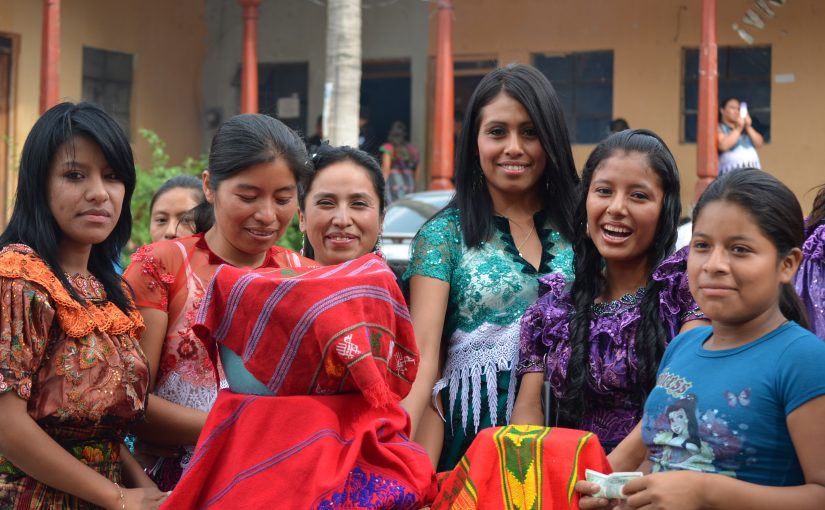
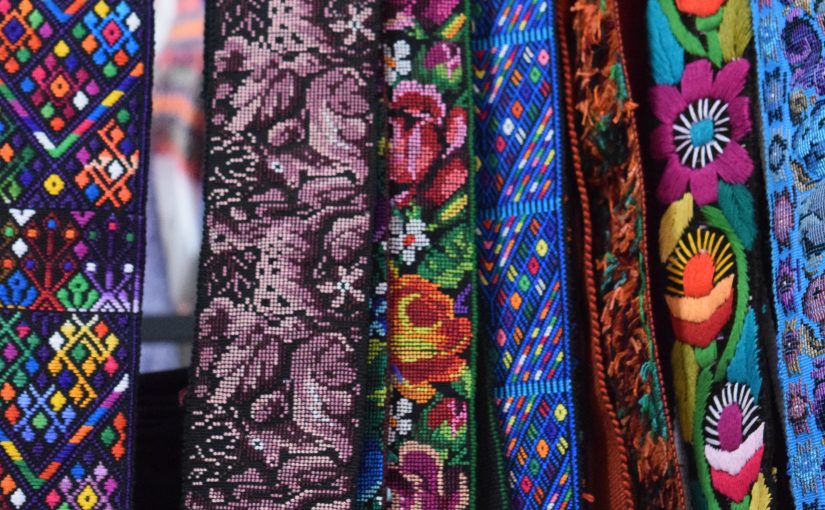
    In this lesson, you will learn about traditional clothing in Nahualá. Nahualeños are very proud of their traditional vestments, especially women, who still wear it every day. You will also practice the grammar and vocabulary we have studied in the past ten units.

    powi’ hat
    kami’x shirt
    ta’k embroidered collar (on men’s shirts)
    nim le ta’k. the collar is big
    koxtar male skirt, traditional in Nahualá
    xyal cardigan, sweater
    pantz trousers
    ilb’al glasses
    ilb’al ramaj watch
    po’t huipil, woven blouse
    uq (E-uq) corte, skirt
    xajab’ shoe(s)
    su’t large woven cloth used as a covering on top of the head or on the shoulder (for women)
    sutub’al su’t ceremonial cloth (tied around a man’s head)
    peraj large woven cloth (larger than su’t) used to carry babies
    xkinaj (E-xikin) ear rings
    mulq’ab’ ring
    chachal necklace
    ximb’al -wi'(aj) hair ribbon
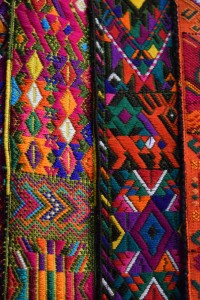
    pas woven belt
    b’ake’t leather belt worn by men, holds the koxtar in place
    to’q diaper
    b’otz’b’al long wide woven belt used to wrap infants
    In the following word scramble are several words concerning clothing. Find them and practice their pronunciation and meaning.
    A Q J N K’ W N X O’ J S P A S K’ U P B’ S
    Y P O’ X Y A L X T’ X Y L TZ U R TZ O O’ U
    R J T’ X K’ W M U P E P R L R X Y J L T
    U’ TZ X Q B’ R L M O U X E’ Y TZ P K’ TZ L U
    U K’ Y Q J Q S L W X R M R P U U P W B’
    P T’ U K’ P N O’ Q I’ Y U’ M X Q R K J Q A
    W L L U’ T R U B’ I’ B’ J O I’ A E’ X T’ A L
    K’ T E R R O U B’ X P Q W M E P U P Y S
    P E’ Q S P N P M A Q S M A T S U O’ L U’
    K K J R U Y J X K X Q Q K E’ K K L Q T
    Q A X J B’ O’ N A S T’ N R 0’ A’ Q B’ R U’ Y
    P B’ A N S Y U B’ R W Q N M E M J W T R
    T’ W TZ Q O’ K’ P TZ U’ S L S U’ T i Y S Q P
    O’ X W J X N T’ X TZ W U W K’ U J K’ E U J
    Q N U X K O X T A R R P Y O’ Q M U’ M T’
    Word Bank: powi’, pas, uq, xyal, po’t, kami’x, su’t, koxtar, sutub’al sut, b’ake’t.

    Translate the following sentences to English:

    1. K’o umulq’ab’ le al Xwa’n.
    2. Nim le b’otz’b’al ne’.
    3. Je’l taq le xkinaj.
    4. K’o ximb’al uwi’ le al To’n.
    5. Paqal rajil le chachal.
    Answers
    1. Juana has a ring.
    2. The cloth for wrapping the babies is big.
    3. The earrings are pretty.
    4. Antonia has a hair tie.
    5. The necklace is expensive.

  • Tïjonïk 10 (Unit 10) Kinwar pa le nuch’at. Kinwarik. (I sleep on my bed. I sleep): Intransitive verbs in K’iche’

    Tïjonïk 10 (Unit 10) Kinwar pa le nuch’at. Kinwarik. (I sleep on my bed. I sleep): Intransitive verbs in K’iche’

    In this lesson, we will study intransitive verbs. By the end of this lesson, you will be able to say what you do, for example, eat, sleep, and travel.

    INTRANSITIVE VERBS

    In K’iche’, there is an important distinction between the morphology of transitive and intransitive verbs. Intransitive verbs in K’iche’ include verbs referencing actions that do not directly affect anyone/anything except the agent (you can think about them as having a subject but not an object, if it helps). Verbs like walk, go, dance, sleep, etc. are intransitive. Verbs referencing feelings and mental states are also intransitive: dream, worry, be sad, be happy, etc.

    In K’iche’ the person (agent) is marked in intransitive verbs using a set of prefixes generally known by Mayanists as “set B.”
    Person Singular Gloss Plural Gloss
    1st -in- or –im- before b’ I -oj- We
    2nd -at- You -ix- You all
    2nd (Formal) -la You (Formal) -alaq You all (Formal)
    3rd Ø He/she/it -e- or glottal stop They
    Table 1. Intransitive verb subject markers (Set B)

    Ex. 1 Kimb’e pa le tinamit. K-im-b’e / pa / le / tinamit Incompletive Aspect – 1st person singular Set B – go / preposition / article / town I go to (the) town. 

    We have already seen with constructions such as possession that K’iche’ is an agglutinative language, which means that particles attach to words to determine their meaning (for example: tinamit, nutinamit, qatinamit). To form a verb in K’iche’, the marker for the person that is doing the action (the agent) becomes part of the verb, as we see with the marker im (1sB: first person singular, set B) in Ex. 1 –B’e is the verb root for the verb “to go.” The k- at the beginning marks the tense or aspect of the verb. In this case, it is in incompletive (INC) aspect; the action is taking place (this is similar, though not equivalent to what we would call the present tense in English).

    Ex. 2 La katb’e pa le tinamit? La  / k-at-b’e    /   pa / le / tinamit INT / INC-2sB-go / prep. / art. / town Are you going to town?

    In Ex. 2 the second person singular markerat (2sB) precedes the verbal root b’e. The so-called incompletive aspect marker k- (INC) precedes the person marker. The marker k- references ongoing or habitual actions. Note the interrogative proclitic la (INT) preceding the phrase. Like in the first example, pa (prep) is a preposition and le is an article (art).

    Ex. 3 Je’, kimb’ek. Je’, / k-im-b’e-k Yes, / INC-1sB-go-PFM Yes, I am going (to town).

    When an intransitive verb comes at the end of a phrase, it takes a phrase final marker (PFM). This marker is usually -ik, though for the verb b’e it’s just -k. In Ex. 3 the suffix –k is a phrase final marker (PFM).

    As you can see in the table above, the third person singular (he/she/it) is not marked. Instead of the marker, as a place holder we’ve written as Ø. In Nahualá, if the intransitive verb begins with a consonant, an a is added to the aspect marker k- in order to avoid having two consonants in a row. The third person singular form of “to go,” then, as you will see below, is kab’ek in phrase final position, or kab’e in a sentence such as “the student goes” “Kab’e le tijoxel” where the verb is not at the end of the phrase. The formal markers for the second person singular and plural (la, alaq) actually come after the verb, so verbs in the formal will never have a phrase final marker. Look over the following table, where b’e is marked and broken down for each person:
    Aspect Person Root  Formal PFM Complete Gloss
    k- in / im b’e -k
    kimb’ek
    I go
    k- at b’e -k
    katb’ek
    you go
    ka- b’e la
    kab’e la
    you go (formal)
    ka- Ø b’e -k  
    kab’ek
    he / she goes
    k- oj / uj b’e -k
    kojb’ek
    we go
    k- ix b’e -k
    kixb’ek
    you all go
    ka- b’e alaq
    kab’e alaq
    you all go (formal)
    k e b’e -k
    keb’ek
    they go
    Now take a look at the verb war(ik), “to sleep.” Can you predict how this verb would be marked for each person before looking at the table?
    Aspect Person Root  Formal PFM Complete Gloss
    k- in / im war -ik
    kinwarik
    I sleep
    k- at war -ik
    katwarik
    you sleep
    ka- war la
    kawar la
    you sleep (formal)
    ka- Ø war -ik
    kawarik
    he / she sleeps
    k- oj / uj war -ik
    kojwarik
    we sleep
    k- ix war -ik
    kixwarik
    you all sleep
    ka- war alaq
    kawar alaq
    you all sleep (formal)
    k e war -ik
    kewarik
    they sleep
     
    pet(ik) to come
    “Kimpe pa…” “I am from…” (Literally: I come from)
    wa’lij(ik) to get up
    wa'(ik) to eat
    el(ik) to leave, to go out
    ch’aw(ik) to speak
    opan(ik) to arrive (at a place where you are not at the time)
    ul(ik) to arrive (at the place where you are at the time)
    “Kinopan pa le tijob’al.” “I arrive at school” (said if you are not at school)
    “Kinul pa le tijob’al.” “I arrive at school” (said if you are at school)
     

    Mark the following verb roots with each grammatical person.

    1. wa’lij(ik) – to get up
    2. ch’aw(ik) – to talk/speak
    3. chakun(ik) – to work
    4. b’in(ik) – to walk
    5. wa'(ik) – to eat
    6. etz’an(ik) – to play
    7. pet(ik) – to come
    Answers
    1. Kinwalijik; katwalijik, kawalij la, kawalijik; kojwalijik; kixwalijik; kawalij alaq; kewalijik
    2. Kinch’awik; katch’awik; kach’aw la; kach’awik; kojch’awik; kixch’awik; kach’aw alaq; kech’awik
    3. Kinchakunik; katchakunik; kachakun la; kachakunik; kojchakunik; kixchakunik; kachakun alaq; kechakunik
    4. Kimb’inik; katb’inik; kab’in la; kab’inik; kojb’inik; kixb’inik; kab’in alaq; keb’inik
    5. Kinwa’ik; katwa’ik; kawa’ la; kawa’ik; kojwa’ik; kixwa’ik; kawa’ alaq; kewa’ik
    6. Kinetz’anik; katetz’anik; ketz’an la; ketz’anik; kojetz’anik; kixetz’anik’ ketz’an alaq; ke’tz’anik
    7. Kimpetik; katpetik; kape la; kapetik; kojpetik; kixpetik; kape alaq; kepetik
    Go back to the tzijonik. Can you understand it better than the first time you read it? Can you write a few sentences about yourself and what you do everyday?

  • Tïjonik 9 (Unit 9) E k’i le aj k’ayib’ pa le k’ayb’al! (There are lots of merchants at the market!): Plurals in K’iche’

    Tïjonik 9 (Unit 9) E k’i le aj k’ayib’ pa le k’ayb’al! (There are lots of merchants at the market!): Plurals in K’iche’

    In this lesson, we will learn about plural forms to reference multiple objects and people. There are several ways to pluralize words and sentences in K’iche’.

    Nouns

    Plural nouns are marked with the suffix –Vb’, where V = Vowel. If the last vowel of the noun is –i or –e, the plural suffix is –ab’:

    1. In ajtij. “I am a teacher.”

    Oj ajtijab’. “We are teachers.”

    2. Are tijoxel. “He/she is a student.”

    A’re’ e tijoxelab’. “They are students.”

    Note that a’re “they” is the plural of are “he/she”. When appearing as predicates of third person plural subjects, plural nouns require an agreement proclitic e (as in e tijoxelab’ “students” in Ex. 2).

    If the last vowel of the noun is –a, -o, -u, the plural suffix is –ib’:

    3. At ixoq. “You are a woman.”

    Ix ixoqib’. “You all are women.”

    4. At ajchak.“You are a worker.”

    Ix ajchakib’. “You all are workers.”

    If the noun begins with a vowel, the proclitic e that marks plurality becomes a glottal stop inserted after the first vowel of the third person plural noun (a’jchakib’).

    There are some exceptions to the vowel rule above. In almost of all of them, however, the meanings of the plural form are somewhat different from the singular:

    5. k’ajol “son (of a man)”

    k’ajolab “young men, male youth”

    6. ak’al “child”

    ak’alab’ “children”

    7. ali “girl, unmarried young woman”

    altomab’ “girls”

    8. ala “boy, unmarried young man”

    alab’om “boys”

    9. achi “man”

    achijab’ “men”

    10. ati’t “grandmother, female animal”

    ati’tab’ “female animals”

    11. ama’ “male animal”

    ama’ib’ “male animals”

    Adjectives

    Adjectives do not have plural forms except the following (the plural suffix is -aq)

    12. ch’uti’n / ch’utiq “small”

    13. nim / nimaq “big”

    14. chom / chomaq “fat”

    15. pim / pimaq “thick”

    When the adjective is acting as sentence predicate, a glottal stop is required after the ‘a’ in –aq.

    16. Le nimaqa taq ja. “The big houses”

    17. Nima’q le ja. “The houses are big”

    18. Nima’q taq le ja. “The houses are big”

    For a more in-depth explanation of adjectives see lessons 28 and 29.

    Proclitic particle ‘taq

    Plural nouns are marked with the proclitic taq.

    19. Le nimaq taq ja. “The big houses.”

    b) In existential and stative sentences: When the predicate is a plural noun, the particle taq precedes the article. The reader should be aware that in K’iche’ predicates precede subjects unlike Spanish or English.

    20. Saq taq le ja. “The houses are white.”

    In Ex. 20, the predicate saq “white” precedes the subject taq le ja “the houses”.

    21. Rax taq le kotz’i’j. “The flowers are green.”

    22. E k’a’n taq le tz’i’. “The dogs are fierce.”

    When referencing animate nouns the agreement marker e before the predicate is preferred as in Ex. 22.

    23. E k’a’n le tz’i’. “The dogs are fierce.”

    In example 23, the proclitic e is the sole plural marker as the proclitic taq does not appear preceding the subject le tz’i’ “the dogs.”

    24. E utz le winaq. “The people are good.”

    In like fashion, in example 24, the proclitic e before the predicate utz is the only plural marker.

    25. E nima’q le altomab’. “The girls are big.”

    In Ex. 25 both the predicate nima’q and the subject altomab’ bear plural markers.

    26. A’re wa’ le e wal. “These here are my kids” (spoken by a woman).

    In example 26, the agreement proclitic e precedes wal “my kids.” Note the plural marking on the pronoun a’re “they.”

    27. A’re wa’ le e nuchikop. “These here are my animals.”

    28. E tijoxelab’ le a’chijab’. “The men are students.”

    Note the agreement proclitics (e and glottal stop) on both plural nouns in the predicate e tijoxelab’ and in the subject le a’chijab’.

    29. A’jtijab’ le achijab’. “The men are teachers.”

    In contrast to Ex. 28, the subject achijab’ does not show proclitic agreement in Ex. 29.

    30. E’laq’omab’ taq le achijab’. “The men are thieves.”

    31. E k’o kajib’ uk’ajol le tat Wel. “Don Manuel has four sons.”

    32. Jawi’ e k’o wi le awal? “Where are your children?” (addressed to a woman).

    In existential sentences the proclitic e precedes the existential k’o as in Ex. 31. The cardinal number kajib’ “four” marks the subject as plural. Possessed nouns such as uk’ajol “his sons” are not pluralized.

    Finally, there is an additional proclitic particle with a diminutive, affective connotation that indicates affection or appreciation towards the subject: staq, as in Ex. 33 below. Do not confuse this with taq, which is a distributive/diminutive as well (Ex. 34).

    33. Kewar le staq imul. “The cute/little rabbits are sleeping.”

    34. Kewar le taq imul. “The cute/little rabbits are sleeping.”

    35. K’o taq ab’aj pa le b’e. “There are little rocks on the road.”

    jun one
    keb’ two
    oxib’ three
    kajib’ four
    jo’ob’ five
    waqib’ six
    wuqub’ seven
    wajxaqib’ eight
    b’elejeb’ nine
    lajuj ten
    pix tomato
    ichaj herbs
    kaqa q’oq’ watermelon
    q’an (inkine’y, prut) banana
    saqwach  potato
    saqmo’l egg
    kinaq’ bean

    Transform the following sentences into plural, then translate them into English:

    1. K’o jun ajk’ay prut pa le k’ayb’al.
    2. K’o jun tz’i’ pa le b’e.
    3. La k’o le awuj? Je’, k’o nuwuj.
    4. Ajk’ay pix le wachi’il.
    5. K’o jun achi pa le k’ayb’al.
    Answers
    1. E k’o ajk’ay taq prut pa le k’ayb’al. (There are banana sellers in the market.)
    2. E k’o taq le tz’i’ pa le b’e. (There are dogs on the street.)
    3. La k’o taq le awuj? Je’ k’o taq le nuwuj. (Do you have your books? Yes, I have my books.)
    4. Ajk’ay taq pix le e wachi’il. (The tomato sellers are my friends.)
    5. E k’o achijab’ pa le k’ayb’al. (There are men in the market.)

  • Tïjonïk 8 (Unit 8)  La k’o le anan? (Is your mom home?): How to ask yes/no questions

    Tïjonïk 8 (Unit 8) La k’o le anan? (Is your mom home?): How to ask yes/no questions

    In this unit you will learn how to ask questions. Next, we will take a look at how to construct negative sentences, which are a bit complex in K’iche’.

    Yes/no questions in K’iche’ In K’iche’ yes/no questions simply require placing the particle La at the beginning as well as adding a raising intonation at the end. Listen carefully to the examples below.
    -La k’o le atat? -Je’, k’olik.
    -Is your dad (home)? -Yes, he is.
    The particle je’ is utilized as yes. As we have seen, the particle k’o becomes k’olik when it is in the phrase final position.
    -La xukul le a Xwan? – Je’, xukulik.
    -Is Xwan kneeling? -Yes, he is.
    – La oj oj nab’e? – Je’, oj oj nab’e.
    -Are we first? -Yes, we are first
    Please listen to the following examples and practice answering the questions.
    – La k’o awe? – K’olik. OR:
    – Je’, k’o we.
    -Do you have a girlfriend/boyfriend? -I do.-Yes, I have a girlfriend/boyfriend.
    – La nim le atinamit? – Je’ nim. OR:
    – Je’, nim le nutinamit.
     -Is your town big? -Yes, (it is) big. -Yes, my town is big.
    – La at k’o ruk’ le atz’i’? – In k’olik. OR:
    – Je’, in k’o ruk’ le nutz’i’.
    -Are you with your dog? -I am. -Yes, I am with my dog.
    – La rax le juyub’? – Je’, rax. OR:
    – Je’, rax le juyub’.
     -Is the mountain green? -Yes, (it is) green. -Yes, the mountain is green.
    – La k’o le ajastaq? – Je’, k’olik. OR:
    – Je’, k’o le nujastaq.
    -Do you have your things? -Yes, I do. -Yes, I have my things.
    – La awachalal le al We’l? – Je’, wachalal. OR:
    – Je’, wachalal le al We’l.
    -Is Manuela your relative? -Yes, (she is)my relative.-Yes, Manuela is my relative.
    – La ix k’o pa le tijob’al? – Je’ oj k’olik. OR:
    – Je’, oj k’o pa le tijob’al.
     -Are y’all at the school? -Yes, we are.-Yes, we are at the school.
     

    Negation in non-verbal sentences In Nahuala K’iche’, the negative answer to yes/no questions is maj. The Spanish loanword no’ (with a glottal stop) is often heard as well. An answer with maj alone may be interpreted as somewhat curt but sometimes it is enough. Negation in K’iche’ is periphrastic, in other words, it requires two negation markers as in French, for example. The first is the (optional) particle na preceding the predicate. The second (obligatory) particle is ta or taj in sentence final position. Negative existential sentences in Nahuala start with maj and do not carry the existential k’o/k’olik. Let’s look at some examples:

    Na nim ta r-aqan wa’ we chaj. Negation big Negation its-leg this tree This pine (tree) is not tall. (Remember the construction nim raqan means tall)

    Na rax ta u-wach le juyub’. Neg. green neg. its-face art. mountain The mountain is not green.

    Maj u-rajil le q’abarel. Neg. his/her-money art. drunk (person) The drunk (person) has no money. 

    Na utz ta le u-t’iso’m le al Mari’y Neg. good neg. art. her-sewing art. class. Mari’y Maria’s sewing is not good.

    Na q’an ta u-wach le qa-prut Neg. yellow neg. its-face art. our-banana Our banana is not ripe (yellow). 

    Maj jab’ wa’ kamik Neg. rain today There is no rain today.

    Maj uwaq’ij iwir Neg. sun rays yesterday There was no sun today. 

    sak’aj smart, bright
    k’ax difficult
    chaq’ younger sibling of the same sex
    chwe’q tomorrow
    iwir yesterday
    kamik today
    chanim right now
    jab’ rain
    uwaq’ij sun rays
    prut banana
    q’abarel drunk (person)
    t’iso’m sewing
    jastaq things
    -achalal family relative
     

    From the following word pairs, form questions indicating possession and answer them in the affirmative and in the negative. Example : at/ixoqil : La k’o awixoqil ? –Je’, k’olik. /Maj. -Do you have a wife? Yes, I do./ No, (I do not).

    1.   At/wuj
    2.  Al Nela/chak/pa tijob’al
    3.   At/ xajab’
    4. Nan Xe’p/po’t
    5.  A Si’s, al Xe’p/xajab’
    6.  At/chak
    7. Ajtij/chakub’al/pa Nahualja’
    8. Ix/pwaq
    9. Tz’i’/wa
    10. B’i/tz’i’
    11. At/chaq’
    Answers
    1. La k’o le awuj? Je’ k’olik. Maj.
    2. La k’o uchak al Nela pa tijob’al? Je’ k’olik. Maj.
    3. La k’o axajab’? Je’ k’olik. Maj.
    4. La k’o upo’t le Nan Xe’p? Je’ k’olik. Maj.
    5. La k’o kixajab’ le a Si’s chi’l le al Xe’p? Je’ k’olik. Maj.
    6. La k’o achak? Je’ k’olik. Maj.
    7. La k’o uchakub’al le ajtij pa Nawalja’? Je’ k’olik. Maj.
    8. La ix k’o ipwaq? Je’ k’olik. Maj.
    9. La k’o uwa le tz’i’? Je’ k’olik. Maj.
    10. La k’o ub’i’ le tz’i’? Je’ k’olik. Maj.
    11. La k’o achaq’? Je’ k’olik. Maj.
    Now, practice asking and answering the following questions in k’iche:
    1. Are you in the United States?
    2. Do you (plural) have a dog?
    3. Xwan, is your younger brother home?
    4. Is your dad a lumberjack?
    5. Are you drunk?
    6. Is the mayor in his office?
    7. Are we smart at school?
    8. Is the k’iche’ class difficult?
    9. What’s your name (addressing an elder)?
    10. Is Mari’y’s huipil green?
    Answers
    1. La at k’o pa Estados Unidos? Je’ in k’olik. In maj.
    2. La ix k’o jun itz’i’? Je’ k’olik. Maj.
    3. Xwan, la k’o le achaq’ pa awo’ch? Je’ k’olik. Maj.
    4. La b’anal si’ le atat? Je’ b’anal si’ le nutat. Na b’anal si’ ta le nutat.
    5. La at q’abarel? Je’, in q’abarel. Na in q’abarel taj.
    6. La k’o le alkalte’ pa uchakub’al? Je’ k’olik. Maj.
    7. La oj sak’aj pa tijob’al? Je’ oj sak’aj pa tijob’al. Na oj sak’aj taj.
    8. La k’ax le tijonik re K’iche’? Je’ k’ax le tijonik. Na k’ax ta le tijonik.
    9. Jas b’i’ la? Max le nub’i’.
    10. La rax le upo’t le al Mari’y? Je’, rax le upo’t. Na rax ta le upo’t.

  • Tïjonïk 7 (Unit 7) Ub’antajik le nutinamit (How’s my hometown)

    Tïjonïk 7 (Unit 7) Ub’antajik le nutinamit (How’s my hometown)

    So far you have learned how to use possession markers, the existential particle k’o, and pronouns. In this lesson, you will explore non-verbal sentences, a syntactic category that works differently from English or Spanish because K’iche’ does not have an equivalent of English ‘to be’.

    Non-verbal sentences.  Unlike Spanish and English, K’iche’ does not have a copula (to be). This means that in existential and descriptive sentences like “the man is tired,” the adjective (tired) takes on the roles as predicate; subject (man) and predicate (tired) are simply juxtaposed. In K’iche’, the predicate precedes the subject. Use le as a generic article “the” (we will study articles in greater detail in another lesson).
    9 Man returning from the fields, Chwi Raxon, Nahuala
    Kosnaq le achi. tired art. man The man is tired.
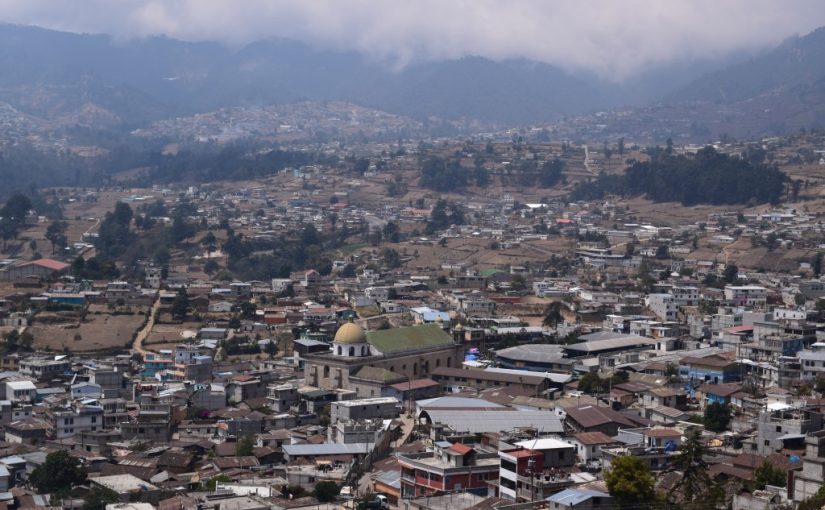
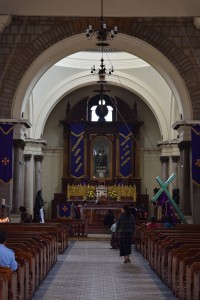
    1 Nahuala church transept Je’l le tyox. pretty art. church The church is pretty.
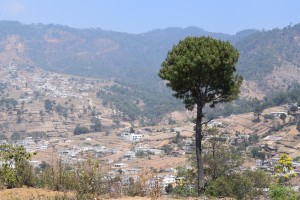
    6 Chwi Pa Tuj, Nahuala Nim raqan le che’. tall art. tree The tree is tall.
    4 Nahuala church
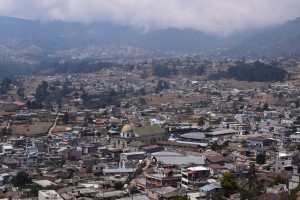
    Sib’alaj nim le tinamit. very big art. town The town is very big.
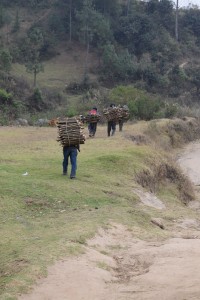
    8 Carrying firewood 2 K’ax le ki-b’e le e winaq. hard art. their-road art. pl. people The people’s road is hard.
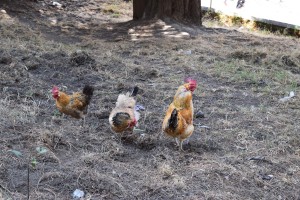
    10 Free range fowl at Uxlanb'al, Nahuala E k’o oxib’ ak’. pl. ex. three hens There are three hens.
    3 Huipil store, Nahuala 13 K’ak’ le po’t. new art. huipil The huipil is new.
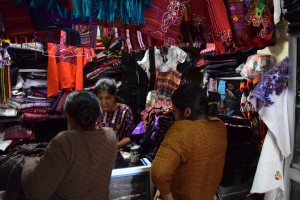
    Phrases with k’o describe existing things in a place or location. Often a prepositional phrase (K’o oxib’ ixoqib’ pa k’ayib’al atz’yaq) (There are three women at the clothing store) is used.
    2 Huipil store, Nahuala 8 E k’o ixoqib’ pa le k’ayb’al. pl. ex. women prep. art. market There are women at the market.
    5 Forest, Chirij Raxon, Nahuala
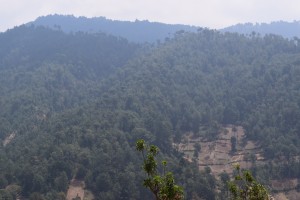
    K’o che’ pa le k’ache’laj. ex. tree prep. art. forest There are trees in the forest.
    7 Children, Chirij Kumento, Nahuala
    E k’o kajib’ ak’alab’ pa le b’e. pl. ex. four children prep. art. road There are four children on the road.
    Here are a few more examples. Can you translate them into English?:
    Nim raqan le achi.

    Rax le usu’t le nunan.

    Chom le jun la’j me’s.
    Ko le ab’aj.
    Pa’tz uwi’ le qatz’i’.

    ab’aj rock, stone
    ab’ix cornfield, milpa
    achi/achijab’ man/men
    ak’al/ak’alab’ child/children
    ala/alab’om boy/boys
    ali/altomab’ girl/girls
    amu’s ladino, mestizo, a non-indigenous person
    b’e road
    chak work, job
    chakub’al working place, office
    chaq’ younger sibling of the same sex
    chi’ here, mouth
    chikop animal
    chila’ there
    chom fat
    ixoq/ixoqib’ woman/women
    juyub’ mountain, hill
    k’a’n mean, fierce
    k’ajol son (of man)
    k’ak’ new
    -k’isb’al the last one of
    ko hard
    la’j small
    me’s cat
    nim big
    nim raqan tall (literally: big his/her/its-leg)
    nitz’ small
    pa preposition (at, in, to, towards)
    palaj face
    paqal expensive, high, steep
    pwaq money, precious metals
    q’eq black
    rajil money
    sib’alaj very, much
    wa food

    Translate the following sentences.

    1. Nim le tijob’al
    2. Q’e’l le ratz’yaq le ak’al.
    3. Paqal rajil le nupo’t.
    4. K’o uxajab’ le ixoq.
    5. K’o nuchak pa tijob’al.
    6. K’o uchikopil le che’.
    7. Tat Wel k’o pa le ro’ch le nuchaq’.
    8. K’o upo’t le al We’l.
    Answers
    1. The school is big.
    2. The boy’s clothes are old.
    3. My huipil (woven blouse) is expensive.
    4. The woman has shoes.
    5. I have my job at the school.
    6. The tree has animals.
    7. Mr. Manuel is at his younger brother’s house.
    8. Manuela has a huipil (woven blouse).
    Form stative sentences from the following word pairs, then translate them into English.

    Example: atz’yaq/q’e’l: Q’e’l le atz’yaq. The clothing/clothes are old.

    1. Tz’i’/nim
    2. Nupo’t/q’e’l
    3. Saq’ul/q’an
    4. Qachakub’al/nim
    5. Atz’ib’ab’al/kaq
    6. Chikop/nitz’
    7. Wuj/utz
    8. Ich’ich’/nim
    9. B’e/k’ak’
    10. Qawa/utz
    Answers
    1. Nim le tz’i’. (The dog is big.)
    2. Q’e’l le nupo’t. (My huipil is old.)
    3. Q’an le saq’ul. (The banana is yellow.)
    4. Nim le qachakub’al. (Our office is big.)
    5. Kaq le azt’ib’ab’al. (The pencil is red.)
    6. Nitz’ le chikop. (The animal is small.)
    7. Utz le wuj. (The book is good.)
    8. Nim le ich’ich’. (Your car is big.)
    9. K’ak’ le b’e. (The road is good.)
    10. Utz le qawa. (Our food is good.)