Category: English

  • Tïjonïk 6 (Unit 6) In ajtij; at tijoxel (I am a teacher; you are a student)

    Tïjonïk 6 (Unit 6) In ajtij; at tijoxel (I am a teacher; you are a student)

    In this unit, you will learn about K’iche’ pronouns. We will start with personal pronouns and how to use them in conversation. Next, you will learn how to report the location of people and objects.

    Independent pronouns Independent pronouns–equivalent to English personal pronouns–are used in K’iche’ as subjects of non-verbal predicates as well as for emphasis or topicalization (for example, “As for me, I am sure I’ll learn K’iche’”). They are used more sparsely than in English, however. Non-verbal predicates include stative phrases denoting states, conditions or qualities. Unlike Spanish or English, K’iche’ does not have a verb equivalent to ‘to be’. You will notice that the English translations of the example sentences below require the verb ‘to be’ as copula. In pronominal, non-verbal sentences in K’iche’, independent pronouns occupy the first slot followed by the predicate as in the following examples:
    1. [sc_embed_player  fileurl=”https://tzij.coerll.utexas.edu/wp-content/uploads/pronouns_04_in-ajtij.mp3″]In ajtij. I teacher I am a teacher.
    2. [sc_embed_player  fileurl=”https://tzij.coerll.utexas.edu/wp-content/uploads/pronouns_04_at-rajkun.mp3″]At r-ajkun le nu-nan. You her-doctor art. my-mother You are my mother’s doctor.
    3. [sc_embed_player  fileurl=”https://tzij.coerll.utexas.edu/wp-content/uploads/pronouns_04_are-le-utat.mp3″]Are le u-tat le al Ska’. He art. her-dad- art. class. Francisca He is Francisca’s dad.
    4. [sc_embed_player  fileurl=”https://tzij.coerll.utexas.edu/wp-content/uploads/pronouns_04_oj-ajxojolob.mp3″]Oj ajxojolob’ pa Awas Q’ij. We dancers prep. Holy Week We are dancers on Holy Week.
    5. [sc_embed_player  fileurl=”https://tzij.coerll.utexas.edu/wp-content/uploads/pronouns_04_are-ral.mp3″]A’re e r-al le nan We’l. They her-children art. class. Manuela They are the children of mrs. Manuela.
    Look at the table of independent pronouns. Note that the pronouns are not marked for gender like in the third person in English (in other words, there is no difference between the pronoun for she and he).
    in
    I
    oj/uj
    we
    at
    you
    ix
    you (pl)
    lal
    you (formal)
    alaq
    you (pl, formal)
    are(’)
    he/she/it
    a
    ’re(’)
    they
    The glottal stop after “are(‘)” and “a’re(‘)” appears when phrase final. We have already seen these pronouns, for example, in greetings:
    1. La utz awach? – Utz maltyox, e k’u ri at? – Utz maltyox. How are you? – Well, thank you, and you?– Well, thank you.
    2. La utz wach la? – Utz maltyox, e k’u ri lal ? – Utz maltyox. How are you (formal) – Well, thank you, and you (formal)?– Well, thank you.
    Let’s look at more examples:
    1. In
      ajtij. I teacher I am a teacher.
    2. At
      tijoxel You student You are a student.
    3. Are
      utz u-na’oj He/she/it good his-knowledge He is a good man/woman (she/he has good character/ buena gente).
    4. Lal
       k’amal b’e you (formal) leader You (formal) are a leader.
    Locative sentences Locative sentences, as the name suggests, describe the location of the subject. In K’iche’, locative sentences consist of independent pronouns in the first slot followed by the existential particle k’o and its locative complement, in other words, the place where the subject is. As we have seen in stative phrases, we use the verb “to be” when glossing the sentence in English. Note that if a third person subject is plural the form e k’o is used (we will discuss plurals in more detail in lesson 9). If a third person is explicit, it precedes the existential k’o as well. Let’s look at the following examples:
    1. At k’o
      pa swan! at k’o pa swan You ex. prep. ravine You are in the ravine!
    2. Oj k’o
      pa le r-o’ch le a Wel. we ex. prep. his-house Manuel We are at Manuel’s house.
    3. In k’o
      pa le u-k’isb’al cholaj. I ex. prep. its-last row/lane I’m in the last row.
    If the subject of the sentence is the third person singular pronoun, the particle k’o stands alone.
    1. K’o
      pa tijob’al Ex. prep. school He/she/it is at school.
    If the subject of the sentence is the third person plural pronoun, e precedes the particle k’o:
    1. E k’o
      pa tijob’al They ex. prep. school They are at school.
    2. E k’o
      keb’ u-k’ajol le tat Xwan They ex. two his-sons art. class. Juan Mr. Juan has two sons.
    Emphasis, topicalization, and independent pronouns When the subject is topicalized or emphatic contrast is stressed, independent pronouns are copied in sentence-initial position.
    1. In in
      k’o pa tijob’al! I am the one who is at school!
    2. At at
      le utaqo’n le q’atal tzij! You are the one who is the judge’s messenger!
    3. Are le Tu’r
      le loq’omanel! Venturo is the one who is the buyer!
    4. Oj oj wokol ja! We are the ones who are construction workers!
    5. Ix ix e’laq’omab’! You all are the ones who are thieves!
    tz’ib’ab’al pencil, pen, chalk
    wuj book
    uxaq wuj piece of paper
    wanke’t table, desk
    tem chair
    chim bag, backpack
    rax green, blue
    q’eq black
    q’an yellow
    saq white
    kaq red
    ajtij teacher
    tijoxel student
    tikonel farmer (someone who plants)
    ajtij teacher
    ajkun doctor
    pare’ priest
    kojol b’aq nurse, pharmacist
    chakunel worker
    k’amal b’e leader; president; traditionally a person who is an expert in ceremonial speech, for example for weddings
    ajanel wood worker, carpenter
    ajq’ij calendar specialist, daykeeper, shaman
    Ajik’ maid, domestic worker (someone who is paid by the month – ik’)
    b’insanel ch’ich’ driver
    b’anal si’ someone who gets and sells firewood
    b’anal ch’ajo’n somebody who does laundry for a living
    b’anal wa cook
    wokol ja handyman/woman; construction worker
    alkalte’ mayor

    Translate the following phrases into English.

    1. Oj k’o pa Iximulew.
    2. In ixoq.
    3. Alaq k’o alaq pa juyub’.
    4. A’re’, utz kina’oj.
    5. Rax le nuchim.
    6. La utz wach alaq?
    7. K’o jun tz’i’ pa le nuchakub’al.
    8. In in k’o pa ja.
    9. Are’ le wajtij.
    10. Ix k’o pa le nimatijob’al.
    11. Le qab’ix k’o chila’.
    12. Are’ k’o wuk’.
    13. A’re’ le tijoxelab’.
    14. Oj k’o pa b’e.
    15. K’o jun chi tzij pa le cholaj tzij.
    Answers
    1. We are in Guatemala.
    2. I am a woman.
    3. You all are on the mountain.
    4. They have a good character (good-natured).
    5. My bag is green.
    6. How are you all?
    7. There is a dog in my office.
    8. I am at home.
    9. He/she is my teacher.
    10. You all are at the university.
    11. Our cornfield is over there.
    12. He/she is with me.
    13. They are the students.
    14. We are on the road.
    15. I have another word in the sentence.
    Translate the following phrases into K’iche’.
    1. I have a bag.
    2. I am a teacher.
    3. He is a student.
    4. They are thieves.
    5. They are the ones who are thieves! (focus)
    6. I have two children.
    7. The cook is at Ernesto’s house.
    8. They have shoes.
    9. The priest is at the church.
    10. How is your mom?
    Answers
    1. K’o jun nuchim.
    2. In Ajtij.
    3. Are jun tijoxel.
    4. Ri a’re elaq’omab’.
    5. A’re le e winaq le elaq’omab’.
    6. E k’o keb’ nuk’ajol.
    7. K’o le b’anal wa pa le ro’ch tat Ernesto.
    8. A’re k’o kixajab’.
    9. K’o le pare’ pa le tyox.
    10. La utz uwach le anan?

  • Tïjonïk 5 (Unit 5) K’o jun qat’u’y pa ja! (We have a pot at home!)

    Tïjonïk 5 (Unit 5) K’o jun qat’u’y pa ja! (We have a pot at home!)

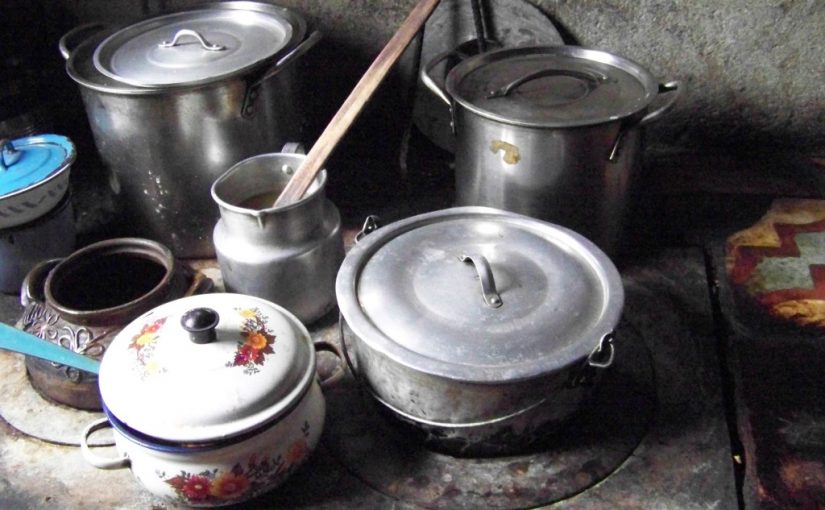
    100_5628

    K’iche’ does not have verbs equivalent to English ‘to have’ and ‘to be’, which introduce existential sentences or possession clauses such as “There is maize in the kitchen” or “I have a mean dog.” In K’iche’, as in most Mayan languages, possession and existence are denoted with a special particle called an “existential” (k’o in K’iche’). The existential k’o often appears in sentence or phrase initial position. In sentence-final position it is replaced with k’olik. In this unit you will learn how to use k’o and its use in conversations.


    Possession The particle k’o followed by a possessed noun indicates possession (which in English is expressed with the verb “to have”), as we see in the examples below:
    Ex. 1 K’o nuwuj k’o nu-wuj Ex my-book I have a book.
    Ex.2 K’o nuwa chi’. k’o nu-wa chi’ Ex my-food here I have food here.
    Ex. 3 K’o uxajab’ ri ak’al. k’o u-xajab’ ri ak’al Ex his-sandals det child The child has sandals.
    Ex. 4 K’o qo’ch chila’ Nawalja’. k’o q-o’ch chila’ Nawalja’ Ex our-house there Nahualá We have a house in Nahualá.
    Ex. 5 K’o iwab’ix pa juyub’. k’o iw-ab’ix pa juyub’ Ex y’all’s-cornfield loc hill You all have a cornfield in the forest/mountain/hill.
    Ex. 6 E k’o kik’ajol le a’chijab’. e k’o ki-k’ajol  le  a’chij-ab’ PL ex their-son (of man) det men-PL The men have sons.
      Existential Sentences The particle k’o also functions as an existential (which in English can be glossed as “There is/There are” or different conjugations of the verb “to be”), as we can see from the examples below:
    Ex. 7 K’o jun ala pa tijob’al. k’o jun ala pa tijob’al Ex one boy loc school There is a boy in the school.
    Ex. 8 K’o jun tz’i’ pa b’e. k’o jun tz’i’ pa b’e Ex one dog loc road There is a dog on the road.
    Ex. 9 At k’o pa swan! at k’o pa swan You Ex. loc ravine You are in the ravine!
    Ex. 10 Oj k’o pa le ro’ch le a Wel. Oj k’o pa le r-o’ch le a Wel. we Ex. loc. det his-house det Manuel We are at Manuel’s house.
    In the following lesson, we will learn more about how to use the existential particle k’o, and we will also learn about personal pronouns. For now, practice using the possessive and existential phrases we have learned in this lesson.
    ab’ix cornfield, milpa
    k’ayib’al market
    swan ravine
    tz’ib’ab’al pen, pencil
    sib’alaj very, much, a lot
    b’e road, path
    t’uy’ pot (for cooking)
    chak work
    achi man
    achijab’ men
    ixoq woman
    ixoqib’ women
    tijonik class, lesson
    rajil money

    Write three sentences using the possessive k’o and three sentences using the existencial k’o.

    Translate the following sentences to K’iche’.

    1. I have a pen.
    2. My friends have a house in Nahualá.
    3. There is a cow on the road.
    4. My mother has a lot of money.
    5. There is a lot of work in the lesson.
    6. We are in the K’iche’ class.
    7. There is a pot in the kitchen.
    8. We have a cornfield in the ravine.
    9. Manuela is at Xwan’s house.
    10. My dad is at the market.
    Answers
    1. In k’o nutz’ib’ab’al.
    2. Le e wachi’il k’o k’och pa Nahualja’.
    3. K’o jun wakax pa le b’e.
    4. Sib’alaj k’o urajil le nunan.
    5. K’i le chak pa we tijonik.
    6. Oj k’o pa le tijonik re K’iche’.
    7. K’o jun t’u’y pa le nuk’b’al.
    8. K’o qab’ix pa siwan.
    9. Al Manuela k’o pa le ro’ch a Xwan.
    10. Le nutat k’o pa le k’ayib’al.

  • Tïjonïk 4 (Unit 4) Are wa’ nuwuj! (This is my book!): K’iche nominal possessive markers

    Tïjonïk 4 (Unit 4) Are wa’ nuwuj! (This is my book!): K’iche nominal possessive markers

    In this lesson, you will learn about nominal possession in K’iche’. It is a bit more intricate than English or Spanish as K’iche’ has a very rich word morphology. You will have plenty of examples and drills!

    Possession

    In K’iche’ nominal possession markers are prefixed on the possessed person/object. Different sets of prefixes are used with consonant-initial nouns and with vowel-initial nouns. The exception is formal address, in which the post-nominal particles la (sing.) or alaq (plural) are used instead of prefixes. See the examples in the table below:
    Before a consonant rajil “money” Before a vowel achi’l “friend”
    nu-rajil my money w-achi’il my friend
    a-rajil your money aw-achi’il your friend
    rajil la your money (formal)  achi’l la  your friend (formal)
    u-rajil his/her money r-achi’il his/her friend
    qa-rajil our money q-achi’il our friend
    i-rajil your money (pl. informal) iw-achi’il your friend (pl.  informal)
    rajil alaq your money (pl. formal) achi’l alaq your friend (pl. formal)
    ki-rajil

    their money k-achi’il

    their friend
    Inherent possession (-Vl) A certain class of K’iche’ nouns may take an additional /-Vl/ suffix. This is known as inherent possession and marks a part-whole relationship between possessor and possessed object/person. For example, there is a semantic difference between nub’aq and nub’aqil. The former references bones that are not part of the possessor’s body, chicken bones used to make soup, for example. The latter, in contrast, means “my body” which references the possessor’s own body. Some nouns take only inherent possession markers (wife, husband), others may take both (bone, house). The large majority of nouns do not take inherent possession markers, however. A few nouns take irregular possessed forms such as house (ja when not possessed, -ochoch when possessed).
    Preconsonantal b’aq ‘bone’ Prevocalic ixoq ‘woman’ o’ch ‘house’
    nu-b’aq-il my body w-ixoq-il my wife w-o’ch my house
    a-b’aq-il your body aw-ixoq-il your wife aw-o’ch your house
    b’aq-il la your body (formal) ixoq-il la your wife (formal) o’ch la  your house (formal)
    u-b’aq-il his/her/its body r-ixoq-il his/her wife r-o’ch  his/her house
    qa-b’aqi-il our body q-ixoq-il our wife q-o’ch our house
    i-b’aq-il your body (pl.) iw-ixoq-il your wife (pl.) iw-o’ch your house (pl.)
    b’aq-il alaq your body (pl. formal) ixoq-il alaq your wife (pl. formal) o’ch alaq your house (pl. formal)
    ki-b’aq-il

    their body k-ixoq-il

    their wife ko’ch

    their house
    Other examples:
    kik’ ‘blood’ – nukik’el ‘my blood’
    kaq ‘red’ – nukaqal ‘my redness
    q’aq’ ‘fire’ – nuq’aq’al ‘my fever’
    suk’ ‘pure’ – nusuk’mal ‘my absence of sin; purity’
     
    wuj book
    che’ tree
    ja house (unpossessed)
    -o’ch house (possessed)
    -ij back of… (possessed)
    achi’il friend
    -wach face (possessed
    -al child (of woman)
    kaq red
    ch’ich’ metal; car
    kik’ blood
    xa’r cup
    wakax cow
    q’oq’ chilacayote
    oj avocado
    ulew tierra
    b’aq bone
    rajil money
    tijonik lesson
    tz’ib’ab’al pencil, pen
     

    Mark all of the following nouns using the possessive markers for all persons:

    1. ch’ich’
    2. kik’
    3. xa’r
    4. wakax
    5. q’oq’
    6. oj
    7. ulew
    8. b’aq
    9. wuj
    10. tijonik
    11. tz’ib’ab’al
    Answers
    1. Nuch’ich’; Ach’ich’; Ch’ich’ la; Uch’ich’; Qach’ich’; Ich’ich’; Ch’ich’ alaq; Kich’ich’
    2. Nukik’el; Akik’el; Kik’el la; Ukik’el; Qakik’el; Ikik’el; Kik’el alaq; Kikik’el
    3. Nuxa’r; Axa’r; xa’r la; Uxa’r; Qaxa’r; Ixa’r; xa’r alaq; Kixa’r
    4. Nuwakax; Awakax; wakax la; Uwakax; Qawakax; Iwakax; wakax alaq; Kiwakax
    5. Nuq’oq’; Aq’oq’; q’oq’ la; Uq’oq’; Qaq’oq’; Iq’oq’; q’oq’ alaq; Kiq’oq’
    6. Woj; Awoj; oj la; Roj; Qoj; Iwoj; oj alaq; Koj
    7. Wulew; Awulew; ulew la; Rulew; Qulew; Iwulew; ulew alaq; Kulew
    8. Nub’aqil; Ab’aqil; b’aqil la; Ub’aqil; Qab’aqil; Ib’aqil; b’aqil alaq; Kib’aqil
    9. Nuwuj; Awuj; wuj la; Uwuj; Qawuj; Iwuj; wuj alaq; Kiwuj
    10. Nutijonik; Atijonik; tijonik la; Utijonik; Qatijonik; Itijonik; tijonik alaq; Kitijonik
    11. Nutz’ib’ab’al; Atz’ib’ab’al; tz’ib’ab’al la; Utz’ib’ab’al; Qatz’ib’ab’al; Itz’ib’ab’al; tz’ib’ab’al alaq; Kitz’ib’ab’al

  • Tïjonïk 3 (Unit 3) Rutzil wachaj (Greetings)

    Tïjonïk 3 (Unit 3) Rutzil wachaj (Greetings)

    This unit introduces the most common greetings. Click on each example, listen to the audio, and read along. Repeat each formula aloud paying attention to Juan Manuel’s pronunciation. Finally, you will also learn several common K’iche’ names.

    The following are common greetings:
    Saqirik!
    Good morning!
    Xb’e q’ij!
    Good afternoon!
    Xok aq’ab’!
    Good evening!
    Jeb’a’!
    Good bye!
    Tat
    Sir
    Nan
    Ma’am
    Ala
    Boy
    Ali
    Girl
    Saqirik tat!
    Good morning, sir!
    Xb’e q’ij nan!
    Good afternoon, ma’am!
    Xok aq’ab’ ali!
    Good evening, girl!
    Social status and greetings in K’iche’ K’iche’ greetings change based on the speakers and the context. There are formal and colloquial greetings. In Nahualá, formal address is required to engage town elders, family in-laws, school teachers, church leaders (Catholic priests, catechists, Evangelical pastors) as well as civil authorities (town mayor, departmental governor, and other high government officials). Formal address is also used to address God and other divine beings in religious rituals. It is required to address adult audiences in public functions such as school graduations, political speeches, and masses. Finally, it is commonly used in radio broadcasts to address listeners. Colloquial forms are expected in informal conversations between kin (except between in-laws) as well as between friends. They are also used in market transactions and in brief exchanges between strangers of the same social status.

    Watch each of the following short videos paying special attention to the greetings the speakers utilize.

    [embed-youtube id=”y8cmSlmBFXU”]

    [embed-youtube id=”V4V9QPFxThg”]

    [embed-youtube id=”-kdkjquWGIY”]

    [embed-youtube id=”uSyNcljuVN8″]

    Informal greeting

    A: Xb’e q’ij!
    Good afternoon!
    B: Xb’e q’ij
    Good afternoon!
    A: La utz awach?
    How are you (informal)?
    B: Utz maltyox – E k’u ri at – La utz awach?
    Well, thank you – And you? – How are you?
    A: Utz maltyox!
    Well, thank you!
    [sc_embed_player_template1  fileurl=”https://tzij.coerll.utexas.edu/wp-content/uploads/greetings_03_la-utz-awach.mp3″]

    Formal greeting (addressed to persons of high social status such as in-laws and town authorities)

    A: Saqirik tat/nan!
    Good morning!
    B: Saqirik tat/nan!
    Good morning!
    A: La utz wach la?
    How are you (formal)?
    B: Utz maltyox – E k’u ri lal – La utz wach la?
    Well, thank you! – And you? – How are you?
    A: Utz maltyox!
    Well, thank you!
    [sc_embed_player_template1 fileurl=”https://tzij.coerll.utexas.edu/wp-content/uploads/greetings_03_la-utz-wach-la.mp3″]

    K’iche’ first names

    First names are preceded by a particle known as nominal classifier that indicates gender and marital status of the name holder. Some etymologically Spanish names have their own K’iche’ adapted form.
    K’iche’ first name classifiers masculine feminine
    children / young adults a al
    older adults / married individuals tat nan
    Some common first names in Nahualá
    a Wel (Manuel)
    al We’l (Manuela)
    tat Xwan (Juan)
    nan Xwa’n  (Juana)
    a Pal (Gaspar)
    al Xe’p  (Isabel)
    tat Si’s (Francisco)
    nan Ska’ (Francisca)
    a Lu’ (Pedro)
    al Kante’l  (Candelaria)
    tat Ku’ (Domingo)
    nan Talin (Catarina)
    a Tun (Antonio)
    al Re’n (Lorenza)
    nan Mari’y (Maria)
    [sc_embed_player  fileurl=”https://tzij.coerll.utexas.edu/wp-content/uploads/greetings_03_jas-abi-ala.mp3″]Jas ab’i’, ali/ala? What your-name, girl/boy? What is your name, girl/boy?
    [sc_embed_player  fileurl=”https://tzij.coerll.utexas.edu/wp-content/uploads/greetings_03_jas-bi-la-tat.mp3″]Jas b’i’ la, tat? What your-name (formal), sir? What is your name, sir?

    _________ le nub’i’ _________ this my-name My name is __________

    Maltyox chawe! (informal)
    Thank you!
    Maltyox che la! (formal)
    Thank you!
    Maj kab’ij la! (formal)          Maj kub’ano!
    You are welcome!                  You are welcome!
  • Tïjonïk 2 (Unit 2) Jas ub’anik jun k’otoj chi’aj pa tijonik? (How do we ask questions in class?)

    Tïjonïk 2 (Unit 2) Jas ub’anik jun k’otoj chi’aj pa tijonik? (How do we ask questions in class?)

    In this lesson we introduce a number of colloquial phrases that will be useful in the classroom. Unless working with a native speaker instructor, we recommend you skip this lesson for now and return to it after finishing lesson 10.

    HELPFUL PHRASES FOR THE CLASSROOM
    K’o jun nuk’otoj chi’aj.
    I have a question.
    La k’o jun k’otoj chi’aj?
    Is there a question?
    La k’o jun na kak’oxomaj taj?
    Is there something you don’t understand?
    La k’o na kik’oxomaj taj?
    Is there something you all don’t understand?
    La k’o tzij na kik’oxomaj taj?
    Is there any word you all don’t understand?
    Na kink’oxomaj taj jas karaj kub’ij… 
    I don’t understand what …. means.
    Na kink’oxomaj taj jas che…?
    I don’t understand why…
    Na kink’oxomaj taj. Jas che kab’e le jun tzij…?
    I don’t understand. Why does the word … go here?
    Xinsachik.
    I got lost. I made a mistake.
    Xinsach che le uwokik le tzij.
    I made a mistake constructing the word.
    Xsachan le tzij chwe.
    I forgot that word.
    Xsachan chwe.
    I forgot. I can’t remember.
    Na weta’m taj
    .
    I don’t know
    Jas ub’ixik ….?
    How do you say…?
    Jas ub’ixik …. pa K’iche’?
    How do you say… in K’iche’?
    Jas karaj kub’ij….?
    What does… mean?
    Jas upatan le tzij…?
    What’s the function of the word…?
    La utz we 
    kinb’ij….?
    Is it ok to say…?
    Nutom le tzij…
    I have heard the word…
    Na nutom ta la’ le tzij …
    I have not heard the word…
     
  • Tïjonïk 1 (Unit 1) Jas kab’an che ub’ixik le K’iche’ ch’ab’al? (The sounds of K’iche’)

    Tïjonïk 1 (Unit 1) Jas kab’an che ub’ixik le K’iche’ ch’ab’al? (The sounds of K’iche’)

    This unit introduces the sounds of K’iche’. The goal is to become familiar, first, with the pronunciation of consonants and vowels and, second, with the spelling conventions that are used to write K’iche’. Do not worry if your pronunciation is not perfect. You will improve with practice throughout the course.

    Jas  kab’an che ub’ixik le K’iche’ ch’ab’al (The sounds of K’iche)

    Most of the sounds of K’iche’ will not be challenging for a speaker of English or Spanish, as the reader will soon discover. The series of ejective consonants (b’, t’, k’, q’) will be a bit harder to articulate, but with patience and practice they can be mastered too. It should be noted that vowel length is important as several words are distinguished only by the length of their vocalic articulation. For example, the ä in chäj “pine tree” is short, while the a in chaj “ashes” is long. Short vowels will be spelt with a dieresis diacritic (¨) as in the previous example chäj. We encourage the reader not to feel discouraged if her or his pronunciation is not exactly like a native speaker’s. In this course, we strive to develop communicational competence, not “perfect articulation”! Your pronunciation will improve as you continue to practice and engage with native speakers. Begin by reading the words below and then click on the examples and listen carefully. Repeat the words aloud until you feel comfortable with your pronunciation.

    The sounds of K’iche’ Some features of K’iche’ consonants and vowels are quite different from those of most Indo-European languages. The most striking are a glottalized series of consonants (ejectives) as well as the presence of both short and long vowels. Vowels are sometimes followed by a closure of the glottis (glottal stop) in which case they are followed by an apostrophe (‘).
    p
     
    t
    ch
    tz
    k
    q
     
    b’
    t’
    ch’
    tz’
    k’
    q’
    s
     
    j
    x
    m
    n
    l

    l (final word position)
    r
     
    w
     
    y
    Figure 1. K’iche’ Consonants  
    i/ï
    u/ü
    e/ë
    o/ö
    a/ä
    Figure 2. K’iche’ Vowels


    Next we will see the letters and their pronunciation. Listen to the examples carefully and repeat them out loud. The previous tables will be useful for your reference in the future.

    Consonants  

    /p/

    pïx                   tomato

    pim                  thick

    xpëq               toad

    pop                 mat

    inup               ceiba tree

    /t/

    tiko’n              harvest

    patän               tumpline (mecapal)

    patan               cargo (religious office); (religious) obligation; role, function

    /k/

    ka’                   grinding stone; metate

    mukün          baby squash, ayote

    kok’                 finely ground (adj.)

    tuktuk            woodpecker

    tukur             tecolote, owl

    pëk                  cave

    këj                   horse

    kem                 weaving

    keb’                 two

    /q/

    qulaj                throat, neck

    eqä’n               load

    uq                    corte (traditional skirt)

    aq                    pig

    säqsöj            whitish

    /b’/

    b’aq                 bone

    ab’äj                rock, stone, testicle

    kab’                 raw sugar, honey, bee

    /t’/

    t’ü’y                     pot

    at’ïxnab’           to sneeze

    t’ot’                      snail

    /k’/

    k’ak’                new

    ak’al                child

    k’äq                 flea

    ixk’äq              (finger) nail; talon (bird)

    k’ïm                 grass, fodder

    k’ël                  perikeet

    /q’/

    q’oq’               chilacayote (a kind of big, oblong squash/pumpkin)

    q’e’l                 old (for things)

    q’ëq                 black

    q’aq’                fire

    aq’ab’              night

    /tz/

    tza                   salty

    pä’tz               hairy, bushy

    /ch/

    chak                 work

    k’üch               vulture, zopilote

    chom               fat(adj)

    chomal             meeting

    /tz’/

    tz’i’                 dog

    tz’äläm          wooden plank, cutting board

    kotz’i’j            flower, candle, Maya ceremony, placenta

    sutz’                cloud

    /ch’/

    ch’at                bed

    ch’ab’äl           language

    ch’ö                 mouse

    /s/

    sutz’                cloud

    t’isö’m            sewn (fabric)

    mes                  garbage

    /x/

    xik                   hawk (gavilán)

    ixöq                 woman

    ab’ix                cornfield

    Küx                 Mark, aguardiente (liquor)

    /j/

    jö’q                  corn husk

    ajij                   sugar cane

    ja’                    water

    /m/

    më’s                cat

    mes                  trash

    pamaj              stomach, belly, excrement

    mem                mute

    mam                grandfather

    meb’a’             poor, orphan

    moy                 blind

    möx                 fool, stupid, crazy, left

    /n/

    na’oj                thought, idea, wisdom

    wanke’t         table

    ne’                   baby

    nö’s                 turkey

    nan                  mother, lady

    /l/

    lol                    cricket

    tulül                sapote

    web’al            plate

    al                     heavy

    ul                     landslide

    /r/

    räx                   green, blue

    rajil                  money

    poro’n             fire

    /w/

    winäq              person, people

    iwir                  yesterday

    waral               here

    utiw                 coyote

    ulew                land

    ajaw                lord, owner, God

    wakax            cow

    /y/

    yak                  mountain lion

    yab’il               sickness, state of pregnancy

    k’ayb’al          market

    t’o’y                 hat

    k’oy                spider monkey

    poy                 scarecrow

    Consonants borrowed from Spanish

    In addition to the phonemes shown above, K’iche’ has borrowed some Spanish phonemes (b, f, d, g), which are restricted to Spanish loanwords such as the following:

    bas                   drinking glass

    bin                   wine

    botax                   boots

    doctor              doctor

    dyos                God (the Christian deity)

    parmas             pharmacy, drug store

    grad                 staircase, steps

    Vowels

    K’iche’ has a ten-vowel vocalic inventory, as seen in Figure 2. Vowel length is phonemic, in other words, it indicates different words. As we have seen, short vowels are distinguished from long vowels by a two dot diacritic. Note that vowel length is only important on stressed syllables (in other words, the accented syllable of each word). Most K’iche’ dialects stress word-final syllables only, including the Nahuala dialect.

    /ï/

    ïs                     body hair

    pïx                   tomato

    tzï                    hominy, nixtamal

    /i/

    k’ix                  thistle

    ik’                    moon, month

    tzij                   word

    /ü/

    üs                    mosquito

    jül                    hole

    tzü                   gourd

    /u/

    kuk                  squirrel

    juyub’             mountain

    k’um                squash

    /ë/

    k’ël                  parrot

    tzë’                  laughter

    Të’k                Diego

    /e/

    ek’                   decorative plant, “pie de gallo”

    mem                mute

    jech’                uneven

    /ö/

    kö                   hard

    chö                 lake

    /o/

    xot                  shingle, griddle, comal

    oj                     avocado

    k’oj                  mask

    pom                 incense

    /ä/

    äm                   spider

    äj                     corn-on-the-cob

    q’än                 yellow

    /a/

    mam                grandfather

    k’a’am               string

    q’ä’am             bridge, staircase