Category: Uncategorized

  • Tïjonik 16 (Unit 16) Tajin Kinweta’maj (I am learning): Auxiliary Verbs

    Tïjonik 16 (Unit 16) Tajin Kinweta’maj (I am learning): Auxiliary Verbs

    In this lesson, we will learn about several helping (i.e. auxiliary) verbs.

    The following shows the common use of some auxiliary verb-construction (in English auxiliary verbs are usually followed by the infinitive, like in I want to cry). In K’iche’ a second full verb is often used after the auxiliary.

    Kowinik “to be able to”: The main verb follows a form of “kowinik,” with which it agrees in person and aspect.

    Kinkowinik kimb’ek. K-in-kowin-ik k-im-b’e-k INC-1sing-be able to-pfm  INC-1sing-go-pfm. I can go.

    Xatkowinik xab’ano. x-at-kowin-ik x-a-b’an-o COMP-2sing-be able to-pfm COMP-2sing-do-pfm. You were able to do it. / You could do it.

    Kinkowinik kink’am b’i le pwaq we karaj le nutat. k-in-kowinik  k-in-k’am  b’i  le  pwaq we ka-r-aj le nu-tat INC-1sing-be able to   INC-1sing-take  directional art. money if INC-3sing-want art. my-dad I can take away the money if my dad wants.

    La kakowin alaq kinto’ alaq? La ka-Ø-kowin alaq k-in-Ø-to’ alaq? INT INC-Ø-be able to 2pl INC-1sing-Ø-help? Can you all (formal) help me?

    Aj “want” (vtr): In a construction with the verb aj “want” the following main verb does not have to agree in person with –aj-.
    Kawaj ka-w-aj I want (it)
    Kaqaj Ka-q-aj We want (it)
    Kawaj k-aw-aj You want (it)
    Kiwaj k-iw-aj You (pl) want (it)
    Kaj la K-Ø-aj la You (formal) want (it)
    Kaj alaq k-Ø-aj alaq You (formal, pl) want (it)
    Karaj ka-r-aj He/she wants (it)
    Kakaj ka-k-aj They want (it)
    [sc_embed_player fileurl=”https://tzij.coerll.utexas.edu/wp-content/uploads/auxiliar_15_ex-kawaj-kimbe-pa-tinamit.mp3″]Kawaj kimb’e pa tinamit. Ka-w-aj k-im-b’e pa tinamit. INC-1sin-want INC-1sing-go loc. town I want to go to town

    Xawaj xab’ano. x-aw-aj x-a-b’an-o COMP-2sing-aj COMP-2sing-do-pfm You wanted to do it.

    La kaj la kujtzalij la aninaq? La k-Ø-aj la k-uj-tzalij la aninaq? INT INC-Ø-want 2sing,formal INC-1pl-return dir. fast Do you (formal) want us to return here quickly?

    La kaj la koje’xojowa chwe’q? La k-Ø-aj la k-oj-e’-xojow-a chwe’q? INT INC-Ø-want 2sing,form. INC-1pl-incorporated movement-dance-PFM tomorrow Do you (formal) want us to go dance tomorrow?

    Rajawaxik “it is necessary”, “to need”: The irregular passive stem (ajawaxik) of the verb aj “want” becomes the base for the phrase rajawaxik “it is necessary.” The subject and nature of the need is expressed in a following verb. “Rajawaxik” may also be used as a noun: a necessary thing.

    Rajawaxik katzijon le nan ruk’ le tat. It is necessary that the mom talk to the dad.

    Rajawaxik kaya’ kan le pwaq wuk’ in. It is necessary to leave the money with me.

    Rajawaxik kaya’ kan le qawa rumal le aj ik’. It is necessary that our maid give us food.

    Jas rajawaxik kab’anik? What must be done?/ What’s necessary to be done?

    Chab’ij chwe we k’o jun rajawaxik. Tell me if you have a need/if you need something.

    Tajin : describes an ongoing action or an event happening at the same time as another (“progressive” English: I am/was talking). In K’iche this idea is expressed by the word katajin(ik), which is the followed by a transitive or intransitive verb in the incompletive aspect (with proper person). In colloquial speech katajin is shortened to tajin.

    Progressive action in incompletive: katajin + verb in incompletive:
    Katajin ku’l le winaq chanim. The people are arriving now. Progressive action in completive : katajin + verb in incompletive; context makes it clear that event is in the past time:
    Katajin kajosq’ix le ulew aretaq xinopan chi la’. The land was being cleaned when I arrived there. Progressive in future time: katajin + verb; context makes it clear that event takes place in the future:
    Katajin kewa’ le winaq aretaq xujok pa ja. The people will be eating when we enter the house.

    Here are a few more examples:

    Katajin kujwa’ik. We are eating.

    Katajin kixukunaj le itat. Your father is healing you (all).

    Katajin kinkunax waral. I am being healed here.

    Katajin kekunataj le e yawab’ib’. The sick people are being healed.

    La katajin kakunan le ajkun che la? Is the doctor healing you (formal)?

    Lal katajin kakunan la le ne’. You (formal) are healing the baby.


    k’ulanem wedding
    ab’ix cornfield, milpa
    eleb’al bathroom
    uwach ulew the (face of the) Earth
    sutz’ cloud
    b’inel ja’ river
    k’is(o) (vtr) to finish, to run out
    tzaj(ik) (vit) to dry up
    b’in(ik) (vit) to walk, (to go, to move)
    k’iy(ik) (vit) to grow (plants)

    Translate the following phrases into English:

    1. La kakowin alaq kab’e alaq pa le nuk’ulanem?
    2. We kawaj kab’ano, katkowinik kab’ano.
    3. Sib’alaj kakowin le ali kaxojowik.
    4. Rajawaxik le jab’ arech kak’iy le ab’ix.
    5. Rajawaxik kinb’e pa le eleb’al.
    6. Rajawaxik kinb’e pa ro’ch le a Wel.
    7. Rajawaxik kaqachajij le uwach ulew.
    8. Katajin kab’in le sutz’ chwach le kaj.
    9. Katajin katzaj taq le b’inel taq ja’ pa iximulew.
    10. Katajin kak’is le che’ pa we qatinamit.
    Answers
    1. Can you all (formal) come to my wedding?
    2. If you want to do it, you can do it.
    3. The young woman can really dance.
    4. Rain is needed so that the cornfield can grow.
    5. I need to go to the bathroom
    6. I need to go to Manuel’s house.
    7. We need to protect the world.
    8. The cloud is walking across the sky.
    9. The rivers are drying up in Guatemala.
    10. The jail is being finished in our town.
  • Tïjonïk 13 (Unit 13) Xatch’aw ruk’ le awajtij (You spoke with your teacher): Completive Aspect

    Tïjonïk 13 (Unit 13) Xatch’aw ruk’ le awajtij (You spoke with your teacher): Completive Aspect

    In this lesson we will learn to speak about events and experiences in the past. In K’iche’ these are expressed using the completive aspect, which is comparable, though not the same as the past tense.

    In K’iche’ the completive aspect indicates that the action has been completed relative to the time in which it is being spoken. Remember that aspect gives us a text internal perspective of time, how events relate to each other: the completive aspect marks events that have been completed relative to other events. We generally translate the completive with the past in English (I went, I ate, etc.).

    The completive marker is the prefix x-, which replaces the incompletive k(a)-. In the completive, there is no filler vowel –a- in the third person singular linking the aspect marker with the verb stem, like in the incompletive aspect. See the following examples:
    1.
    Katb’ek. K-at-b’ek INC-2sing- go You go.
    1.
    Xatb’ek. x-at-b’ek COMP-2sing-go You went.
    2.
    Kab’ek. Ka-Ø-b’ek. INC-3sing- go He/she/it goes.
     2.
    Xb’ek x-Ø-b’ek COMP-3sing-go He/she/it went.
    3.
    Ximb’ek. x-im-b’ek. COMP-1sing-go I went.
    4.
    Ximb’e ruk’ le ajkun iwir. x-im-b’e r-uk’ le ajkun iwir COMP-1sing 3sing-with art. doctor yesterday. I went to the doctor’s yesterday.
    4.
    La xtzalij la iwir? La x-tzalij la iwir? INT COMP-return 2sing.form yesterday Did you return yesterday?
     5.
    Je’, xintzalijik. Je’, x-in-tzalij-ik. Yes, COMP-1sing-return-pfm. Yes, I returned.
    The pronouns and phrase final markers are the same as for incompletive verbs.
    Aspect Person Root PFM Complete Gloss
    x- im/in b’e -k

    ximb’ek
    I went
    x- at b’e -k

    xatb’ek
    You went
    x-  b’e

    xb’e la
    You went (formal)
    x- Ø  b’e -k

    xb’ek
    He/she/it went
    x- oj  b’e -k

    xojb’ek
    We went
    x- ix  b’e -k

    xixb’ek
    You all went
    x-  b’e

    xb’e alaq
    You all went (formal)
    x- e  b’e -k

    xeb’ek
    They went
    wa’kat(ik) to stroll, to take a walk
    q’ij day
    amaq’ country
    k’a te k’u ri’ then, after
    E-uk’ with (E=ergative)
    oq'(ik) to cry
    ul(ik) to arrive (here)
    kolotaj(ik)* salvation
    kos(ik) to be tired, to tire
    muq(ik)* to bury
    jiq'(ik) to suffocate
    qatat, qanan; qati’t, qamam our ancestors (literally: our fathers, our mothers; our grandmothers, our grandfathers)
    tukinel(ab’) destroyer(s)
    sokotajik* to be wounded
    ch’o’jin(ik) to fight
    uxlab’ breath
    tz’olq’omij remorse, penance, regret
    b’uk’uwem the beating of the earth
    matam late
    aretaq when
    *These are in a grammatical form that we have not studied yet, where the root of a verb is used to make a noun. We will learn this form later.

    Translate the following sentences into English:

    1. Xinwa’kat pa le juyub’ iwir.
    2. Matam xatwa’lij kamik.
    3. Xki’kot le al Maria aretaq xulik.
    4. La xatb’e pa le tyox iwir?
    5. La xixkos pa le ichak?
    6. Xojb’e pa le amaq’ Estados Unidos.
    7. -La xixul pa le tijob’al? -Je’, xojulik.
    8. La xwar le tijoxel pa le tijonik?
    9. Xojch’awik.
    10. Xch’aw le ajtij ruk’ le al We’l.
    Answers
    1. I walked through the mountain yesterday.
    2. You got up late today.
    3. Maria was happy when she arrived here.
    4. Did you go to church yesterday?
    5. Did you all get tired at work?
    6. We went to the country of the United States.
    7. Did you all arrive here at the school? Yes, we arrived here.
    8. Did the student fall asleep in class?
    9. We talked.
    10. The teacher spoke with Manauela.

  • Tïjonïk 7 (Unit 7) Ub’antajik le nutinamit (How’s my hometown)

    Tïjonïk 7 (Unit 7) Ub’antajik le nutinamit (How’s my hometown)

    So far you have learned how to use possession markers, the existential particle k’o, and pronouns. In this lesson, you will explore non-verbal sentences, a syntactic category that works differently from English or Spanish because K’iche’ does not have an equivalent of English ‘to be’.

    Non-verbal sentences.  Unlike Spanish and English, K’iche’ does not have a copula (to be). This means that in existential and descriptive sentences like “the man is tired,” the adjective (tired) takes on the roles as predicate; subject (man) and predicate (tired) are simply juxtaposed. In K’iche’, the predicate precedes the subject. Use le as a generic article “the” (we will study articles in greater detail in another lesson).
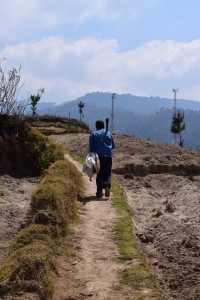
    9 Man returning from the fields, Chwi Raxon, Nahuala
    Kosnaq le achi. tired art. man The man is tired.
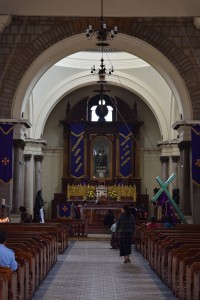
    1 Nahuala church transept Je’l le tyox. pretty art. church The church is pretty.
    6 Chwi Pa Tuj, Nahuala Nim raqan le che’. tall art. tree The tree is tall.
    4 Nahuala church
    Sib’alaj nim le tinamit. very big art. town The town is very big.
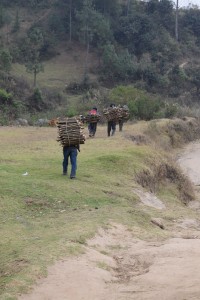
    8 Carrying firewood 2 K’ax le ki-b’e le e winaq. hard art. their-road art. pl. people The people’s road is hard.
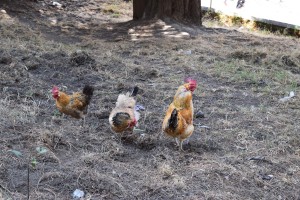
    10 Free range fowl at Uxlanb'al, Nahuala E k’o oxib’ ak’. pl. ex. three hens There are three hens.
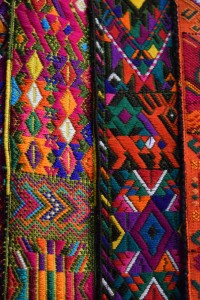
    3 Huipil store, Nahuala 13 K’ak’ le po’t. new art. huipil The huipil is new.
    Phrases with k’o describe existing things in a place or location. Often a prepositional phrase (K’o oxib’ ixoqib’ pa k’ayib’al atz’yaq) (There are three women at the clothing store) is used.
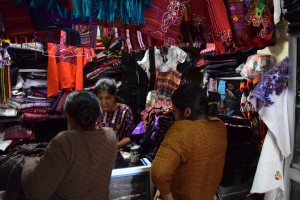
    2 Huipil store, Nahuala 8 E k’o ixoqib’ pa le k’ayb’al. pl. ex. women prep. art. market There are women at the market.
    5 Forest, Chirij Raxon, Nahuala
    K’o che’ pa le k’ache’laj. ex. tree prep. art. forest There are trees in the forest.
    7 Children, Chirij Kumento, Nahuala
    E k’o kajib’ ak’alab’ pa le b’e. pl. ex. four children prep. art. road There are four children on the road.
    Here are a few more examples. Can you translate them into English?:
    Nim raqan le achi.

    Rax le usu’t le nunan.

    Chom le jun la’j me’s.
    Ko le ab’aj.
    Pa’tz uwi’ le qatz’i’.

    ab’aj rock, stone
    ab’ix cornfield, milpa
    achi/achijab’ man/men
    ak’al/ak’alab’ child/children
    ala/alab’om boy/boys
    ali/altomab’ girl/girls
    amu’s ladino, mestizo, a non-indigenous person
    b’e road
    chak work, job
    chakub’al working place, office
    chaq’ younger sibling of the same sex
    chi’ here, mouth
    chikop animal
    chila’ there
    chom fat
    ixoq/ixoqib’ woman/women
    juyub’ mountain, hill
    k’a’n mean, fierce
    k’ajol son (of man)
    k’ak’ new
    -k’isb’al the last one of
    ko hard
    la’j small
    me’s cat
    nim big
    nim raqan tall (literally: big his/her/its-leg)
    nitz’ small
    pa preposition (at, in, to, towards)
    palaj face
    paqal expensive, high, steep
    pwaq money, precious metals
    q’eq black
    rajil money
    sib’alaj very, much
    wa food

    Translate the following sentences.

    1. Nim le tijob’al
    2. Q’e’l le ratz’yaq le ak’al.
    3. Paqal rajil le nupo’t.
    4. K’o uxajab’ le ixoq.
    5. K’o nuchak pa tijob’al.
    6. K’o uchikopil le che’.
    7. Tat Wel k’o pa le ro’ch le nuchaq’.
    8. K’o upo’t le al We’l.
    Answers
    1. The school is big.
    2. The boy’s clothes are old.
    3. My huipil (woven blouse) is expensive.
    4. The woman has shoes.
    5. I have my job at the school.
    6. The tree has animals.
    7. Mr. Manuel is at his younger brother’s house.
    8. Manuela has a huipil (woven blouse).
    Form stative sentences from the following word pairs, then translate them into English.

    Example: atz’yaq/q’e’l: Q’e’l le atz’yaq. The clothing/clothes are old.

    1. Tz’i’/nim
    2. Nupo’t/q’e’l
    3. Saq’ul/q’an
    4. Qachakub’al/nim
    5. Atz’ib’ab’al/kaq
    6. Chikop/nitz’
    7. Wuj/utz
    8. Ich’ich’/nim
    9. B’e/k’ak’
    10. Qawa/utz
    Answers
    1. Nim le tz’i’. (The dog is big.)
    2. Q’e’l le nupo’t. (My huipil is old.)
    3. Q’an le saq’ul. (The banana is yellow.)
    4. Nim le qachakub’al. (Our office is big.)
    5. Kaq le azt’ib’ab’al. (The pencil is red.)
    6. Nitz’ le chikop. (The animal is small.)
    7. Utz le wuj. (The book is good.)
    8. Nim le ich’ich’. (Your car is big.)
    9. K’ak’ le b’e. (The road is good.)
    10. Utz le qawa. (Our food is good.)

  • Tïjonïk 6 (Unit 6) In ajtij; at tijoxel (I am a teacher; you are a student)

    Tïjonïk 6 (Unit 6) In ajtij; at tijoxel (I am a teacher; you are a student)

    In this unit, you will learn about K’iche’ pronouns. We will start with personal pronouns and how to use them in conversation. Next, you will learn how to report the location of people and objects.

    Independent pronouns Independent pronouns–equivalent to English personal pronouns–are used in K’iche’ as subjects of non-verbal predicates as well as for emphasis or topicalization (for example, “As for me, I am sure I’ll learn K’iche’”). They are used more sparsely than in English, however. Non-verbal predicates include stative phrases denoting states, conditions or qualities. Unlike Spanish or English, K’iche’ does not have a verb equivalent to ‘to be’. You will notice that the English translations of the example sentences below require the verb ‘to be’ as copula. In pronominal, non-verbal sentences in K’iche’, independent pronouns occupy the first slot followed by the predicate as in the following examples:
    1. [sc_embed_player  fileurl=”https://tzij.coerll.utexas.edu/wp-content/uploads/pronouns_04_in-ajtij.mp3″]In ajtij. I teacher I am a teacher.
    2. [sc_embed_player  fileurl=”https://tzij.coerll.utexas.edu/wp-content/uploads/pronouns_04_at-rajkun.mp3″]At r-ajkun le nu-nan. You her-doctor art. my-mother You are my mother’s doctor.
    3. [sc_embed_player  fileurl=”https://tzij.coerll.utexas.edu/wp-content/uploads/pronouns_04_are-le-utat.mp3″]Are le u-tat le al Ska’. He art. her-dad- art. class. Francisca He is Francisca’s dad.
    4. [sc_embed_player  fileurl=”https://tzij.coerll.utexas.edu/wp-content/uploads/pronouns_04_oj-ajxojolob.mp3″]Oj ajxojolob’ pa Awas Q’ij. We dancers prep. Holy Week We are dancers on Holy Week.
    5. [sc_embed_player  fileurl=”https://tzij.coerll.utexas.edu/wp-content/uploads/pronouns_04_are-ral.mp3″]A’re e r-al le nan We’l. They her-children art. class. Manuela They are the children of mrs. Manuela.
    Look at the table of independent pronouns. Note that the pronouns are not marked for gender like in the third person in English (in other words, there is no difference between the pronoun for she and he).
    in
    I
    oj/uj
    we
    at
    you
    ix
    you (pl)
    lal
    you (formal)
    alaq
    you (pl, formal)
    are(’)
    he/she/it
    a
    ’re(’)
    they
    The glottal stop after “are(‘)” and “a’re(‘)” appears when phrase final. We have already seen these pronouns, for example, in greetings:
    1. La utz awach? – Utz maltyox, e k’u ri at? – Utz maltyox. How are you? – Well, thank you, and you?– Well, thank you.
    2. La utz wach la? – Utz maltyox, e k’u ri lal ? – Utz maltyox. How are you (formal) – Well, thank you, and you (formal)?– Well, thank you.
    Let’s look at more examples:
    1. In
      ajtij. I teacher I am a teacher.
    2. At
      tijoxel You student You are a student.
    3. Are
      utz u-na’oj He/she/it good his-knowledge He is a good man/woman (she/he has good character/ buena gente).
    4. Lal
       k’amal b’e you (formal) leader You (formal) are a leader.
    Locative sentences Locative sentences, as the name suggests, describe the location of the subject. In K’iche’, locative sentences consist of independent pronouns in the first slot followed by the existential particle k’o and its locative complement, in other words, the place where the subject is. As we have seen in stative phrases, we use the verb “to be” when glossing the sentence in English. Note that if a third person subject is plural the form e k’o is used (we will discuss plurals in more detail in lesson 9). If a third person is explicit, it precedes the existential k’o as well. Let’s look at the following examples:
    1. At k’o
      pa swan! at k’o pa swan You ex. prep. ravine You are in the ravine!
    2. Oj k’o
      pa le r-o’ch le a Wel. we ex. prep. his-house Manuel We are at Manuel’s house.
    3. In k’o
      pa le u-k’isb’al cholaj. I ex. prep. its-last row/lane I’m in the last row.
    If the subject of the sentence is the third person singular pronoun, the particle k’o stands alone.
    1. K’o
      pa tijob’al Ex. prep. school He/she/it is at school.
    If the subject of the sentence is the third person plural pronoun, e precedes the particle k’o:
    1. E k’o
      pa tijob’al They ex. prep. school They are at school.
    2. E k’o
      keb’ u-k’ajol le tat Xwan They ex. two his-sons art. class. Juan Mr. Juan has two sons.
    Emphasis, topicalization, and independent pronouns When the subject is topicalized or emphatic contrast is stressed, independent pronouns are copied in sentence-initial position.
    1. In in
      k’o pa tijob’al! I am the one who is at school!
    2. At at
      le utaqo’n le q’atal tzij! You are the one who is the judge’s messenger!
    3. Are le Tu’r
      le loq’omanel! Venturo is the one who is the buyer!
    4. Oj oj wokol ja! We are the ones who are construction workers!
    5. Ix ix e’laq’omab’! You all are the ones who are thieves!
    tz’ib’ab’al pencil, pen, chalk
    wuj book
    uxaq wuj piece of paper
    wanke’t table, desk
    tem chair
    chim bag, backpack
    rax green, blue
    q’eq black
    q’an yellow
    saq white
    kaq red
    ajtij teacher
    tijoxel student
    tikonel farmer (someone who plants)
    ajtij teacher
    ajkun doctor
    pare’ priest
    kojol b’aq nurse, pharmacist
    chakunel worker
    k’amal b’e leader; president; traditionally a person who is an expert in ceremonial speech, for example for weddings
    ajanel wood worker, carpenter
    ajq’ij calendar specialist, daykeeper, shaman
    Ajik’ maid, domestic worker (someone who is paid by the month – ik’)
    b’insanel ch’ich’ driver
    b’anal si’ someone who gets and sells firewood
    b’anal ch’ajo’n somebody who does laundry for a living
    b’anal wa cook
    wokol ja handyman/woman; construction worker
    alkalte’ mayor

    Translate the following phrases into English.

    1. Oj k’o pa Iximulew.
    2. In ixoq.
    3. Alaq k’o alaq pa juyub’.
    4. A’re’, utz kina’oj.
    5. Rax le nuchim.
    6. La utz wach alaq?
    7. K’o jun tz’i’ pa le nuchakub’al.
    8. In in k’o pa ja.
    9. Are’ le wajtij.
    10. Ix k’o pa le nimatijob’al.
    11. Le qab’ix k’o chila’.
    12. Are’ k’o wuk’.
    13. A’re’ le tijoxelab’.
    14. Oj k’o pa b’e.
    15. K’o jun chi tzij pa le cholaj tzij.
    Answers
    1. We are in Guatemala.
    2. I am a woman.
    3. You all are on the mountain.
    4. They have a good character (good-natured).
    5. My bag is green.
    6. How are you all?
    7. There is a dog in my office.
    8. I am at home.
    9. He/she is my teacher.
    10. You all are at the university.
    11. Our cornfield is over there.
    12. He/she is with me.
    13. They are the students.
    14. We are on the road.
    15. I have another word in the sentence.
    Translate the following phrases into K’iche’.
    1. I have a bag.
    2. I am a teacher.
    3. He is a student.
    4. They are thieves.
    5. They are the ones who are thieves! (focus)
    6. I have two children.
    7. The cook is at Ernesto’s house.
    8. They have shoes.
    9. The priest is at the church.
    10. How is your mom?
    Answers
    1. K’o jun nuchim.
    2. In Ajtij.
    3. Are jun tijoxel.
    4. Ri a’re elaq’omab’.
    5. A’re le e winaq le elaq’omab’.
    6. E k’o keb’ nuk’ajol.
    7. K’o le b’anal wa pa le ro’ch tat Ernesto.
    8. A’re k’o kixajab’.
    9. K’o le pare’ pa le tyox.
    10. La utz uwach le anan?

  • Tïjonïk 5 (Unit 5) K’o jun qat’u’y pa ja! (We have a pot at home!)

    Tïjonïk 5 (Unit 5) K’o jun qat’u’y pa ja! (We have a pot at home!)

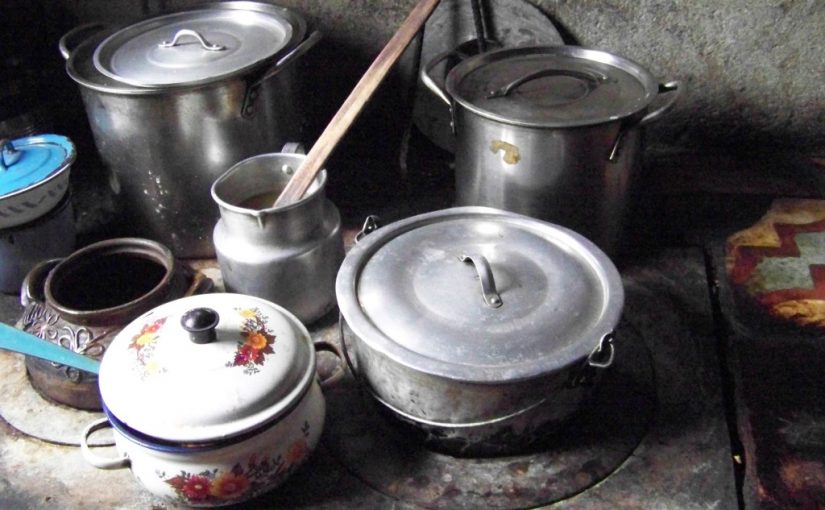
    100_5628

    K’iche’ does not have verbs equivalent to English ‘to have’ and ‘to be’, which introduce existential sentences or possession clauses such as “There is maize in the kitchen” or “I have a mean dog.” In K’iche’, as in most Mayan languages, possession and existence are denoted with a special particle called an “existential” (k’o in K’iche’). The existential k’o often appears in sentence or phrase initial position. In sentence-final position it is replaced with k’olik. In this unit you will learn how to use k’o and its use in conversations.


    Possession The particle k’o followed by a possessed noun indicates possession (which in English is expressed with the verb “to have”), as we see in the examples below:
    Ex. 1 K’o nuwuj k’o nu-wuj Ex my-book I have a book.
    Ex.2 K’o nuwa chi’. k’o nu-wa chi’ Ex my-food here I have food here.
    Ex. 3 K’o uxajab’ ri ak’al. k’o u-xajab’ ri ak’al Ex his-sandals det child The child has sandals.
    Ex. 4 K’o qo’ch chila’ Nawalja’. k’o q-o’ch chila’ Nawalja’ Ex our-house there Nahualá We have a house in Nahualá.
    Ex. 5 K’o iwab’ix pa juyub’. k’o iw-ab’ix pa juyub’ Ex y’all’s-cornfield loc hill You all have a cornfield in the forest/mountain/hill.
    Ex. 6 E k’o kik’ajol le a’chijab’. e k’o ki-k’ajol  le  a’chij-ab’ PL ex their-son (of man) det men-PL The men have sons.
      Existential Sentences The particle k’o also functions as an existential (which in English can be glossed as “There is/There are” or different conjugations of the verb “to be”), as we can see from the examples below:
    Ex. 7 K’o jun ala pa tijob’al. k’o jun ala pa tijob’al Ex one boy loc school There is a boy in the school.
    Ex. 8 K’o jun tz’i’ pa b’e. k’o jun tz’i’ pa b’e Ex one dog loc road There is a dog on the road.
    Ex. 9 At k’o pa swan! at k’o pa swan You Ex. loc ravine You are in the ravine!
    Ex. 10 Oj k’o pa le ro’ch le a Wel. Oj k’o pa le r-o’ch le a Wel. we Ex. loc. det his-house det Manuel We are at Manuel’s house.
    In the following lesson, we will learn more about how to use the existential particle k’o, and we will also learn about personal pronouns. For now, practice using the possessive and existential phrases we have learned in this lesson.
    ab’ix cornfield, milpa
    k’ayib’al market
    swan ravine
    tz’ib’ab’al pen, pencil
    sib’alaj very, much, a lot
    b’e road, path
    t’uy’ pot (for cooking)
    chak work
    achi man
    achijab’ men
    ixoq woman
    ixoqib’ women
    tijonik class, lesson
    rajil money

    Write three sentences using the possessive k’o and three sentences using the existencial k’o.

    Translate the following sentences to K’iche’.

    1. I have a pen.
    2. My friends have a house in Nahualá.
    3. There is a cow on the road.
    4. My mother has a lot of money.
    5. There is a lot of work in the lesson.
    6. We are in the K’iche’ class.
    7. There is a pot in the kitchen.
    8. We have a cornfield in the ravine.
    9. Manuela is at Xwan’s house.
    10. My dad is at the market.
    Answers
    1. In k’o nutz’ib’ab’al.
    2. Le e wachi’il k’o k’och pa Nahualja’.
    3. K’o jun wakax pa le b’e.
    4. Sib’alaj k’o urajil le nunan.
    5. K’i le chak pa we tijonik.
    6. Oj k’o pa le tijonik re K’iche’.
    7. K’o jun t’u’y pa le nuk’b’al.
    8. K’o qab’ix pa siwan.
    9. Al Manuela k’o pa le ro’ch a Xwan.
    10. Le nutat k’o pa le k’ayib’al.

  • Tïjonïk 4 (Unit 4) Are wa’ nuwuj! (This is my book!): K’iche nominal possessive markers

    Tïjonïk 4 (Unit 4) Are wa’ nuwuj! (This is my book!): K’iche nominal possessive markers

    In this lesson, you will learn about nominal possession in K’iche’. It is a bit more intricate than English or Spanish as K’iche’ has a very rich word morphology. You will have plenty of examples and drills!

    Possession

    In K’iche’ nominal possession markers are prefixed on the possessed person/object. Different sets of prefixes are used with consonant-initial nouns and with vowel-initial nouns. The exception is formal address, in which the post-nominal particles la (sing.) or alaq (plural) are used instead of prefixes. See the examples in the table below:
    Before a consonant rajil “money” Before a vowel achi’l “friend”
    nu-rajil my money w-achi’il my friend
    a-rajil your money aw-achi’il your friend
    rajil la your money (formal)  achi’l la  your friend (formal)
    u-rajil his/her money r-achi’il his/her friend
    qa-rajil our money q-achi’il our friend
    i-rajil your money (pl. informal) iw-achi’il your friend (pl.  informal)
    rajil alaq your money (pl. formal) achi’l alaq your friend (pl. formal)
    ki-rajil

    their money k-achi’il

    their friend
    Inherent possession (-Vl) A certain class of K’iche’ nouns may take an additional /-Vl/ suffix. This is known as inherent possession and marks a part-whole relationship between possessor and possessed object/person. For example, there is a semantic difference between nub’aq and nub’aqil. The former references bones that are not part of the possessor’s body, chicken bones used to make soup, for example. The latter, in contrast, means “my body” which references the possessor’s own body. Some nouns take only inherent possession markers (wife, husband), others may take both (bone, house). The large majority of nouns do not take inherent possession markers, however. A few nouns take irregular possessed forms such as house (ja when not possessed, -ochoch when possessed).
    Preconsonantal b’aq ‘bone’ Prevocalic ixoq ‘woman’ o’ch ‘house’
    nu-b’aq-il my body w-ixoq-il my wife w-o’ch my house
    a-b’aq-il your body aw-ixoq-il your wife aw-o’ch your house
    b’aq-il la your body (formal) ixoq-il la your wife (formal) o’ch la  your house (formal)
    u-b’aq-il his/her/its body r-ixoq-il his/her wife r-o’ch  his/her house
    qa-b’aqi-il our body q-ixoq-il our wife q-o’ch our house
    i-b’aq-il your body (pl.) iw-ixoq-il your wife (pl.) iw-o’ch your house (pl.)
    b’aq-il alaq your body (pl. formal) ixoq-il alaq your wife (pl. formal) o’ch alaq your house (pl. formal)
    ki-b’aq-il

    their body k-ixoq-il

    their wife ko’ch

    their house
    Other examples:
    kik’ ‘blood’ – nukik’el ‘my blood’
    kaq ‘red’ – nukaqal ‘my redness
    q’aq’ ‘fire’ – nuq’aq’al ‘my fever’
    suk’ ‘pure’ – nusuk’mal ‘my absence of sin; purity’
     
    wuj book
    che’ tree
    ja house (unpossessed)
    -o’ch house (possessed)
    -ij back of… (possessed)
    achi’il friend
    -wach face (possessed
    -al child (of woman)
    kaq red
    ch’ich’ metal; car
    kik’ blood
    xa’r cup
    wakax cow
    q’oq’ chilacayote
    oj avocado
    ulew tierra
    b’aq bone
    rajil money
    tijonik lesson
    tz’ib’ab’al pencil, pen
     

    Mark all of the following nouns using the possessive markers for all persons:

    1. ch’ich’
    2. kik’
    3. xa’r
    4. wakax
    5. q’oq’
    6. oj
    7. ulew
    8. b’aq
    9. wuj
    10. tijonik
    11. tz’ib’ab’al
    Answers
    1. Nuch’ich’; Ach’ich’; Ch’ich’ la; Uch’ich’; Qach’ich’; Ich’ich’; Ch’ich’ alaq; Kich’ich’
    2. Nukik’el; Akik’el; Kik’el la; Ukik’el; Qakik’el; Ikik’el; Kik’el alaq; Kikik’el
    3. Nuxa’r; Axa’r; xa’r la; Uxa’r; Qaxa’r; Ixa’r; xa’r alaq; Kixa’r
    4. Nuwakax; Awakax; wakax la; Uwakax; Qawakax; Iwakax; wakax alaq; Kiwakax
    5. Nuq’oq’; Aq’oq’; q’oq’ la; Uq’oq’; Qaq’oq’; Iq’oq’; q’oq’ alaq; Kiq’oq’
    6. Woj; Awoj; oj la; Roj; Qoj; Iwoj; oj alaq; Koj
    7. Wulew; Awulew; ulew la; Rulew; Qulew; Iwulew; ulew alaq; Kulew
    8. Nub’aqil; Ab’aqil; b’aqil la; Ub’aqil; Qab’aqil; Ib’aqil; b’aqil alaq; Kib’aqil
    9. Nuwuj; Awuj; wuj la; Uwuj; Qawuj; Iwuj; wuj alaq; Kiwuj
    10. Nutijonik; Atijonik; tijonik la; Utijonik; Qatijonik; Itijonik; tijonik alaq; Kitijonik
    11. Nutz’ib’ab’al; Atz’ib’ab’al; tz’ib’ab’al la; Utz’ib’ab’al; Qatz’ib’ab’al; Itz’ib’ab’al; tz’ib’ab’al alaq; Kitz’ib’ab’al