So far you have learned how to use possession markers, the existential particle k’o, and pronouns. In this lesson, you will explore non-verbal sentences, a syntactic category that works differently from English or Spanish because K’iche’ does not have an equivalent of English ‘to be’.
Non-verbal sentences.
Unlike Spanish and English, K’iche’ does not have a copula (to be). This means that in existential and descriptive sentences like “the man is tired,” the adjective (tired) takes on the roles as predicate; subject (man) and predicate (tired) are simply juxtaposed. In K’iche’, the predicate precedes the subject. Use le as a generic article “the” (we will study articles in greater detail in another lesson).
Phrases with k’o describe existing things in a place or location. Often a prepositional phrase (K’o oxib’ ixoqib’ pa k’ayib’al atz’yaq) (There are three women at the clothing store) is used.
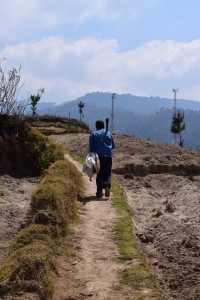 |
Kosnaq le achi. tired art. man The man is tired. |
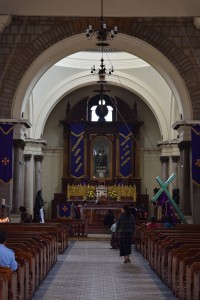 |
Je’l le tyox. pretty art. church The church is pretty. |
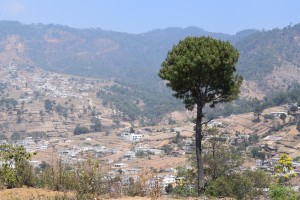 |
Nim raqan le che’. tall art. tree The tree is tall. |
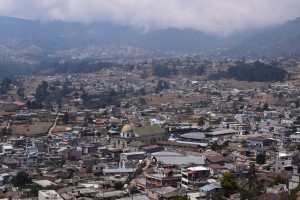 |
Sib’alaj nim le tinamit. very big art. town The town is very big. |
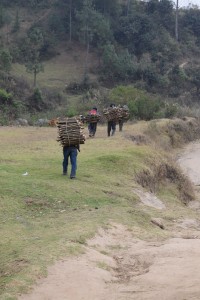 |
K’ax le ki-b’e le e winaq. hard art. their-road art. pl. people The people’s road is hard. |
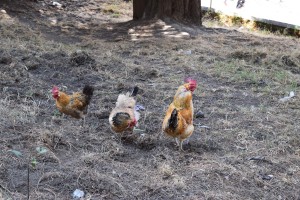 |
E k’o oxib’ ak’. pl. ex. three hens There are three hens. |
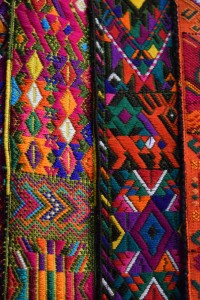 |
K’ak’ le po’t. new art. huipil The huipil is new. |
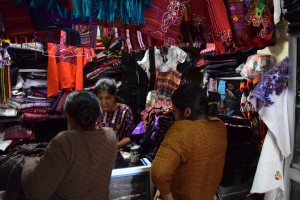 |
E k’o ixoqib’ pa le k’ayb’al. pl. ex. women prep. art. market There are women at the market. |
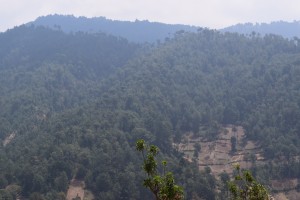 |
K’o che’ pa le k’ache’laj. ex. tree prep. art. forest There are trees in the forest. |
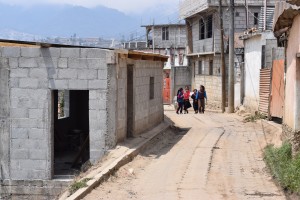 |
E k’o kajib’ ak’alab’ pa le b’e. pl. ex. four children prep. art. road There are four children on the road. |
Rax le usu’t le nunan.
Chom le jun la’j me’s. Ko le ab’aj. Pa’tz uwi’ le qatz’i’.| ab’aj | rock, stone |
| ab’ix | cornfield, milpa |
| achi/achijab’ | man/men |
| ak’al/ak’alab’ | child/children |
| ala/alab’om | boy/boys |
| ali/altomab’ | girl/girls |
| amu’s | ladino, mestizo, a non-indigenous person |
| b’e | road |
| chak | work, job |
| chakub’al | working place, office |
| chaq’ | younger sibling of the same sex |
| chi’ | here, mouth |
| chikop | animal |
| chila’ | there |
| chom | fat |
| ixoq/ixoqib’ | woman/women |
| juyub’ | mountain, hill |
| k’a’n | mean, fierce |
| k’ajol | son (of man) |
| k’ak’ | new |
| -k’isb’al | the last one of |
| ko | hard |
| la’j | small |
| me’s | cat |
| nim | big |
| nim raqan | tall (literally: big his/her/its-leg) |
| nitz’ | small |
| pa | preposition (at, in, to, towards) |
| palaj | face |
| paqal | expensive, high, steep |
| pwaq | money, precious metals |
| q’eq | black |
| rajil | money |
| sib’alaj | very, much |
| wa | food |
Translate the following sentences.
- Nim le tijob’al
- Q’e’l le ratz’yaq le ak’al.
- Paqal rajil le nupo’t.
- K’o uxajab’ le ixoq.
- K’o nuchak pa tijob’al.
- K’o uchikopil le che’.
- Tat Wel k’o pa le ro’ch le nuchaq’.
- K’o upo’t le al We’l.
Answers
- The school is big.
- The boy’s clothes are old.
- My huipil (woven blouse) is expensive.
- The woman has shoes.
- I have my job at the school.
- The tree has animals.
- Mr. Manuel is at his younger brother’s house.
- Manuela has a huipil (woven blouse).
Example: atz’yaq/q’e’l: Q’e’l le atz’yaq. The clothing/clothes are old.
- Tz’i’/nim
- Nupo’t/q’e’l
- Saq’ul/q’an
- Qachakub’al/nim
- Atz’ib’ab’al/kaq
- Chikop/nitz’
- Wuj/utz
- Ich’ich’/nim
- B’e/k’ak’
- Qawa/utz
Answers
- Nim le tz’i’. (The dog is big.)
- Q’e’l le nupo’t. (My huipil is old.)
- Q’an le saq’ul. (The banana is yellow.)
- Nim le qachakub’al. (Our office is big.)
- Kaq le azt’ib’ab’al. (The pencil is red.)
- Nitz’ le chikop. (The animal is small.)
- Utz le wuj. (The book is good.)
- Nim le ich’ich’. (Your car is big.)
- K’ak’ le b’e. (The road is good.)
- Utz le qawa. (Our food is good.)